






























National Agency for Science and Engineering Infrastructure (NASENI) has reaffirmed its commitment to strengthening Nigeria’s industrial value chain through research commercialisation, technology transfer and strategic partnerships with the private sector.
NASENI
The agency said its focus was on bridging the gap between research and commercial production by transforming locally developed technologies into market-ready products capable of reducing import dependence and creating jobs.
According to NASENI, countries such as Japan, China, Singapore and Vietnam have strengthened their industrial sectors by investing in research and development (R&D), innovation, advanced manufacturing and local supply chains.
Read Also: Harvard University Commends Establishment of NASENI-Troment Factory To Eradicate Diseases
The agency noted that Nigeria’s industrial growth had been constrained by the inability to effectively convert research outcomes into commercially viable products.
It said its network of development institutes and manufacturing centres was designed to address this challenge by supporting the entire innovation cycle, from concept development to production and market deployment.
NASENI explained that its model emphasises reverse engineering, technology adaptation and commercialisation of innovations tailored to local needs.
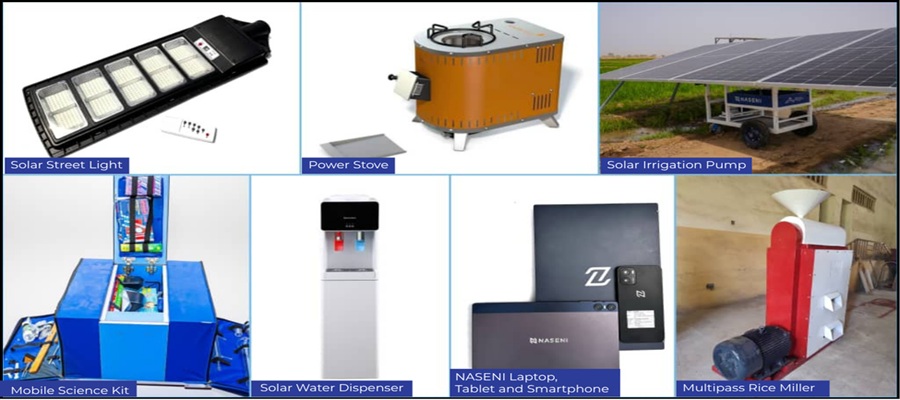
The agency said it had already developed technologies and products across sectors including renewable energy, agriculture, transportation and capital goods manufacturing.
Among the products listed are solar-powered irrigation pumps, rice milling and destoning machines, oil extraction systems, lithium batteries, electric tricycles, hybrid and electric vehicles, laptops, tablets and solar energy solutions.
According to the agency, the technology development process follows a five-stage pipeline comprising research and adaptation, prototype development and testing, pilot production, technology transfer and licensing, and market deployment with after-sales support.
NASENI stated that the framework enables manufacturers and investors to participate at different stages of product development while reducing the risks associated with independent research and development.
It added that businesses adopting NASENI-developed technologies could reduce the time required to bring products to market while benefiting from lower development costs and technical support.
The agency also highlighted the role of its advanced manufacturing centres equipped with computer numerical control (CNC) machines, 3D printers, metrology laboratories and testing facilities.
According to NASENI, the facilities are available to industries on a fee-for-service basis, allowing small and medium-scale enterprises to access modern manufacturing infrastructure without significant capital investment.
The agency said several of its technologies had already progressed through licensing and technology transfer stages, creating opportunities for manufacturers in agriculture, renewable energy and power sectors.
It noted that licensed products are supported with technical documentation, supplier information and training materials to facilitate adoption and local production.
NASENI called on manufacturers, investors, distributors and state governments to partner with the agency in scaling indigenous technologies and strengthening local production capacity.
Also Read: NASENI Empowers 2000 Kano Households with Clean Energy Solutions
The agency urged interested stakeholders to explore its technology catalogue, request technical briefings and participate in industry engagement forums aimed at promoting collaboration and industrial development.
It expressed confidence that stronger partnerships between government, industry and research institutions would accelerate Nigeria’s transition towards a more competitive and innovation-driven manufacturing sector.
According to NASENI, the infrastructure, technical expertise and product designs are already in place, while the next phase requires increased industry participation to scale production and expand the market for Made-in-Nigeria products