



















The Revenue Mobilisation Allocation and Fiscal Commission (RMAFC) has completed its review of Nigeria’s Revenue Allocation Formula, setting the stage for a possible new framework for sharing revenue among the Federal, state and local governments.
The commission also announced that it had concluded the review of salaries and allowances for judicial office holders, while the review covering executive and legislative office holders had reached an advanced stage.
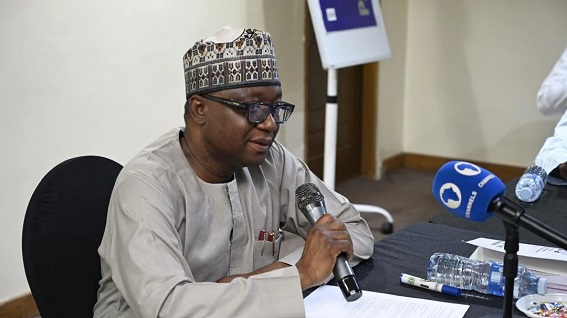
RMAFC Chairman, Mohammed Bello Shehu, disclosed this during an interactive session with members of the Nigerian Guild of Editors in Lagos.
According to Shehu, the revenue allocation review followed extensive consultations with the three tiers of government, technical experts and other relevant stakeholders across the country.
He said the exercise examined fiscal responsibilities, revenue trends and comparative federal systems before producing a harmonised report and legislative proposals for transmission to the appropriate authorities.
“The Commission has completed a comprehensive review of Nigeria’s Revenue Allocation Formula,” Shehu said.
He added that the review of remuneration for judicial office holders had resulted in the enactment of the Judicial Office Holders (Salaries and Allowances) Act, 2025.
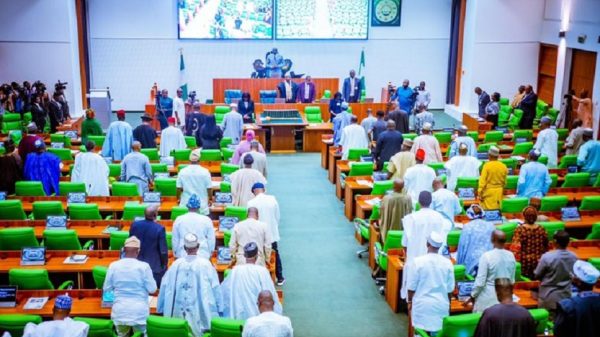
The RMAFC chairman also disclosed that the review of remuneration for political and public office holders in the executive and legislative arms was nearing completion, with an executive bill expected to be forwarded to the National Assembly.
Shehu said the reforms were designed to promote a more equitable and sustainable revenue-sharing system that reflects Nigeria’s changing economic and governance realities.
He, however, stressed that any increase in public officials’ remuneration must be accompanied by improved accountability and performance.
“Remuneration reforms must be matched with accountability and performance. Improved pay should translate into improved service delivery,” he said.
RMAFC Intensifies Oil Revenue Monitoring
Beyond the revenue allocation review, Shehu said the commission had strengthened its monitoring of oil and gas production data to ensure the accurate application of the 13 per cent derivation principle.
He said RMAFC had deployed verification exercises, geospatial mapping and collaboration with relevant government agencies to resolve discrepancies in oil well attribution and ensure that states received revenues due to them.
One of the major interventions, he noted, was the reallocation of 17 oil wells from Imo State to Rivers State in compliance with a Supreme Court judgment.
Similar interventions had also been carried out in Cross River, Akwa Ibom, Imo and Anambra states, while improved gas production reporting had enabled Enugu and Kogi states to benefit from derivation revenues.
Shehu said the commission was working with agencies including the Nigerian Upstream Petroleum Regulatory Commission, NNPC Limited, the Nigerian Midstream and Downstream Petroleum Regulatory Authority, the National Boundary Commission and the Office of the Surveyor-General of the Federation.
He added that RMAFC was engaging the Ministry of Defence over crude oil theft, pipeline vandalism and production losses, which he described as major threats to government revenue.
Commission Seeks New Revenue Sources
The commission is also exploring revenue opportunities outside the petroleum sector.
Shehu said RMAFC was considering partnerships with the Federal Airports Authority of Nigeria and the National Space Research and Development Agency, including the use of satellite and geospatial technologies to identify additional revenue sources.
According to him, the initiatives form part of RMAFC’s broader efforts to improve data integrity, strengthen inter-agency cooperation and promote a fairer distribution of national revenue.
He said the commission had also improved its institutional infrastructure through the rehabilitation of critical facilities, enhanced security systems and the ongoing renovation of its headquarters.
Staff welfare, he added, had received attention through improved healthcare, training and capacity-building programmes.
Shehu said the engagement with the Nigerian Guild of Editors was part of efforts to promote transparency and improve public understanding of RMAFC’s constitutional responsibilities.
He reaffirmed the commission’s commitment to data-driven reforms, proactive communication and collaboration with the media to strengthen accountability in public finance.
In his vote of thanks, the Chairman of RMAFC’s Public Affairs and Communication Committee and Federal Commissioner representing Kwara State, Ismail Muhammed Agaka, commended the media for its contribution to democratic accountability.
RMAFC is constitutionally responsible for monitoring revenue accruing to and distributed from the Federation Account, reviewing the revenue allocation formula and determining appropriate remuneration for political and public office holders.
The completion of the latest revenue allocation review could pave the way for discussions between the Federal Government and the National Assembly on a new approach to distributing federally collected revenues among the three tiers of government.