






















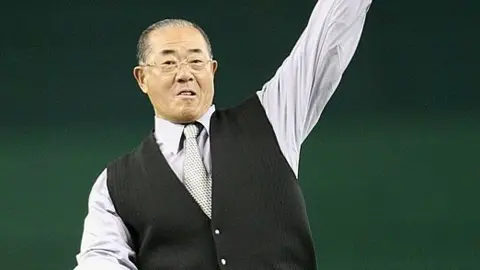
Japanese baseball legend Isao Harimoto, who survived the 1945 atomic bombing of Hiroshima as a child, has died in Tokyo at the age of 86, BBC Sport reported on Thursday.
Harimoto, popularly known as the “Hit Machine,” holds the record for the most hits in Japanese professional baseball history, recording 3,085 hits during a 23-season career.
He remains the only player in Nippon Professional Baseball (NPB) history to reach the 3,000-hit milestone.
Beyond his remarkable hitting record, Harimoto hit 504 home runs and stole 319 bases, making him the only NPB player to achieve at least 500 home runs and 300 stolen bases. In Major League Baseball, only Barry Bonds, Willie Mays and Alex Rodriguez have reached the same combination.
Harimoto was selected for the All-Star Game 18 times and helped the Toei Flyers win their first Japan Series championship in 1962. He was inducted into the Japanese Baseball Hall of Fame in 1990.
Born Jang Hun in Hiroshima in 1940 to Korean parents, Harimoto grew up in post-war Japan at a time when Koreans faced widespread discrimination and legal restrictions. He later adopted the Japanese name Isao Harimoto and obtained Japanese citizenship later in life.
His journey to baseball stardom was further complicated by a childhood accident that severely burned his right hand. The injury restricted movement in his thumb and forefinger and left his other fingers curled.
As a result, Harimoto learned to throw and bat left-handed and used a specially designed glove on his injured right hand.
Survivor of Hiroshima Atomic Bombing
Harimoto was also a survivor of one of the most devastating events of the 20th century.
On August 6, 1945, when he was five years old, he was in Hiroshima when the United States dropped an atomic bomb on the city.
Harimoto later recalled that his mother shielded him and his sister with her body when the bomb exploded. Another sister was killed in the attack.
Despite his difficult childhood, Harimoto went on to establish one of the most extraordinary careers in Japanese baseball.
He joined the Toei Flyers in 1959 and spent 16 seasons with the club before later playing for the Yomiuri Giants and Lotte Orions. He won seven batting titles, including four consecutive titles from 1967 to 1970, a feat later matched by Ichiro Suzuki.
Harimoto retired in 1981 after appearing in 2,752 games.
Following his playing career, he contributed to the development of professional baseball in South Korea, helping launch the country’s KBO league in 1982. He later became a prominent baseball commentator and analyst.
The Golden Players Club, known as Meikyukai, paid tribute to Harimoto following his death, expressing its respect and gratitude for his contributions to the sport.
Harimoto leaves behind a remarkable legacy that extends beyond his extraordinary statistics. He overcame disability, discrimination and the trauma of surviving the Hiroshima atomic bombing to become one of Japan’s most celebrated baseball players.