
























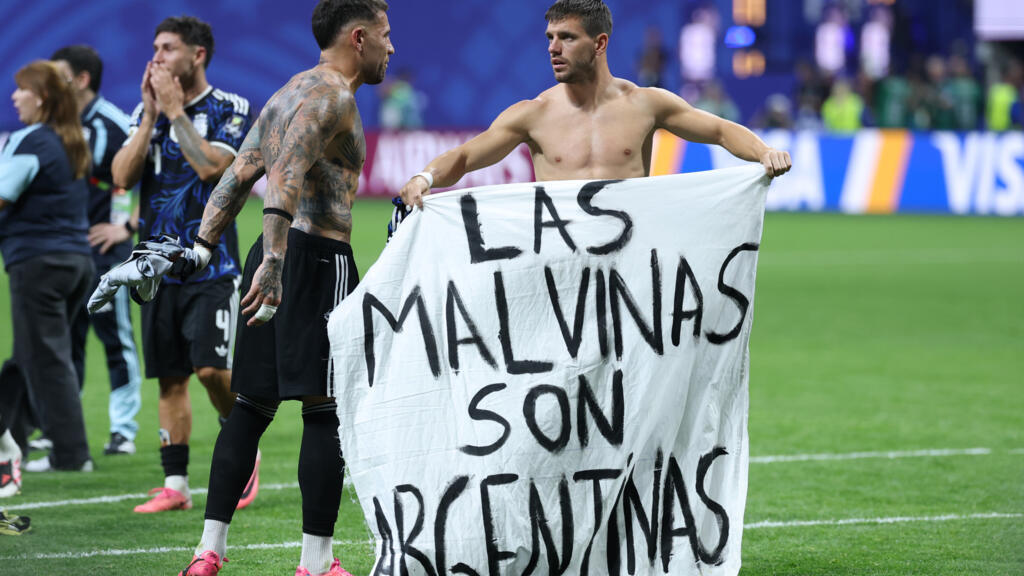
The British Government has called on FIFA to investigate Argentina‘s national football team after several players displayed a banner asserting Argentina’s sovereignty over the disputed Falkland Islands following their World Cup semi-final victory over England.
The controversy followed Argentina’s 2-1 victory over England on Wednesday in Atlanta, where players posed with a banner bearing the inscription, “Las Malvinas son Argentinas” (“The Malvinas are Argentine”), referring to the Falkland Islands by their Argentine name.
UK Business Secretary Peter Kyle described the display as inappropriate and urged FIFA to launch a formal investigation into the incident.
“I hope FIFA will do a proper inquiry,” Kyle said, adding that political issues should remain separate from football.
The office of Prime Minister Keir Starmer also backed calls for an investigation, reaffirming Britain’s position that the Falkland Islands remain a British Overseas Territory.
“The World Cup might not be ours, but the Falkland Islands definitely are,” a Downing Street spokesperson said.
The spokesperson added that Britain’s commitment to the islands remained unchanged and that the principle of self-determination rested with the islanders.
Liberal Democrat leader Ed Davey also criticised the Argentine players, calling for those involved to face disciplinary action.
The Falkland Islands, located in the South Atlantic about 480 kilometres off Argentina’s coast, have remained the subject of a sovereignty dispute between Britain and Argentina for decades.
The disagreement led to the 1982 Falklands War, which ended with Britain retaining control of the islands.
FIFA’s disciplinary regulations prohibit political, ideological, religious or offensive messages during competitions and provide for sanctions, including financial penalties, for violations.
Players reportedly seen with the banner included Lisandro Martínez, Alexis Mac Allister and Cristian Romero.
Martínez defended the team’s actions, saying they could not disappoint the Argentine people, while midfielder Leandro Paredes described the issue as a painful part of Argentina’s history.
FIFA had not issued an official response to the incident as of Thursday.
The governing body has previously sanctioned national football associations over political displays at international tournaments.
The latest controversy comes ahead of Sunday’s FIFA World Cup final between Argentina and Spain in East Rutherford, New Jersey.