


























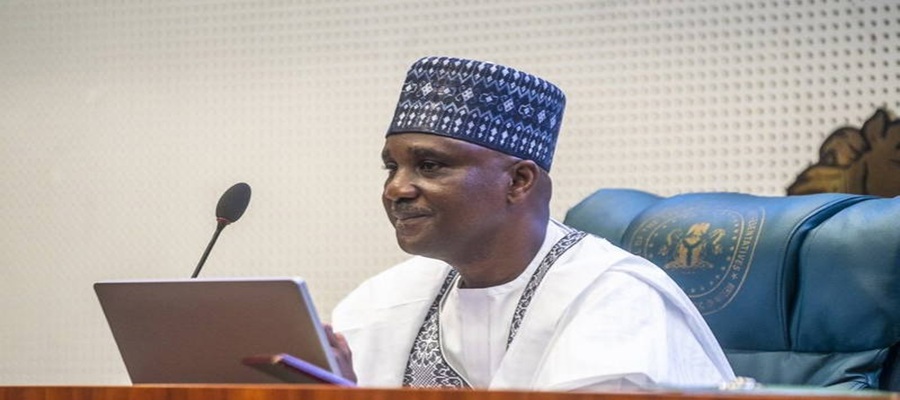
Rep. Abbas Tajudeen, Speaker of the House of Representatives, has defended the proposed State Police Bill, saying it contains adequate constitutional safeguards to prevent governors and political actors from using state police as private security outfits.
Abbas gave the assurance on Wednesday during the National Security Roundtable held as part of activities marking the 2026 National Assembly Open Week in Abuja.
He acknowledged concerns that state police could be abused by governors or political leaders but said the drafters of the proposed legislation deliberately introduced measures to prevent such abuse.
“I understand the concern that many people bring to this discussion, and it is a reasonable one. It is the fear that a State Police could become the private army of a governor or a political godfather.
“The people who drafted this Bill had the same fear, and they answered it,” he said.
The Speaker explained that under the proposed constitutional amendment, governors would not have exclusive powers to appoint or remove state Commissioners of Police.
According to him, appointments would be made on the recommendation of the National Police Council and would require confirmation by the State House of Assembly, while removal would require the support of two-thirds of lawmakers and must be based on proven misconduct.
Abbas also said the proposed legislation empowers the Federal Police to intervene where a state police service becomes compromised, but only under clearly defined constitutional conditions.
“If a State Police breaks down, or falls into the wrong hands, or turns against the very people it should protect, the Constitution allows the Federal Police to step in only in defined situations, only in writing, only for a limited period, with notice to the governor and to the National Assembly within 48 hours, and always subject to the courts,” he said.
He stressed that the proposal would not permit the Federal Government to dissolve a state police service or suspend elected state institutions, describing the provisions as necessary safeguards for Nigeria’s federal system.
The Speaker commended President Bola Tinubu for transmitting an Executive Bill on state police to the National Assembly, describing it as a historic step after decades of debate.
“For the first time in our history, a sitting President has made State Police a central part of national reform,” he said.
Abbas argued that Nigeria’s centralised policing structure was no longer sufficient to tackle emerging security challenges such as banditry, kidnapping, farmer-herder conflicts and attacks on schools.
He said the proposed amendment would rename the Nigeria Police Force as the Federal Police Service while allowing states that meet constitutional requirements to establish their own police services.
According to him, no state police service would commence operations until the relevant State House of Assembly enacted enabling legislation and the state satisfied operational standards prescribed by the National Assembly.
He added that under the proposal, the Federal Police Service would retain responsibility for terrorism, border security, federal offences and policing of the Federal Capital Territory, while state police would focus on maintaining law and order within their respective states.
Abbas further stated that state police services would be supervised by independent State Police Service Commissions, receive direct funding and operate under strict constitutional restrictions against the use of police powers for political, ethnic or religious purposes.
Drawing from policing models in Germany, Canada, India and the United States, the Speaker said effective federal policing systems rely on strong accountability, national standards and intelligence sharing.
He assured Nigerians that the National Assembly would carefully consider issues relating to funding, operational standards, intelligence coordination and the integration of existing vigilante and community security groups before passing the proposed legislation.