




























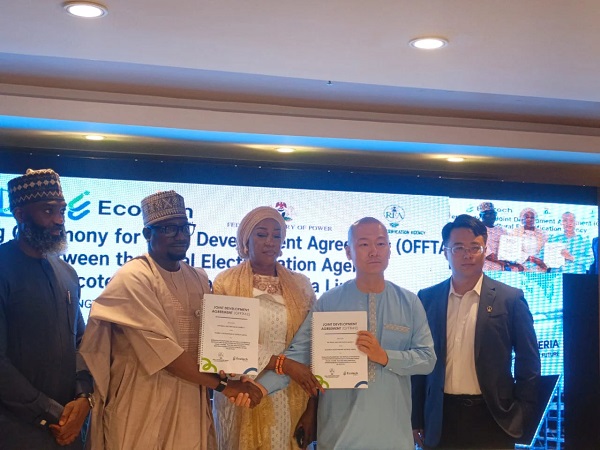
The Rural Electrification Agency (REA) has entered into a strategic partnership with Ecotech Development Nigeria Limited to strengthen local manufacturing of renewable energy equipment, a move aimed at reducing Nigeria’s dependence on imported solar technologies while accelerating rural electrification.
Speaking at the signing ceremony, the Managing Director of the REA, Abba Aliyu, said that despite significant progress in expanding electricity access through initiatives such as the Rural Electrification Fund, the Nigerian Electrification Project, and the Distributed Access through Renewable Energy Scale-Up Project, millions of Nigerians remain without reliable electricity.
According to him, more than 85 million Nigerians—nearly 40 per cent of the population—still lack dependable access to grid electricity, underscoring the need to expand both power infrastructure and local manufacturing capacity.
Aliyu lamented Nigeria’s heavy reliance on imported solar equipment, noting that most solar installations across the country are built with components produced overseas.
“Every electrified community across Nigeria tells the same story. The solar panels, batteries and inverters powering these systems were manufactured abroad. Nigeria provides the market and the demand, while other countries supply the technology,” he said.
He argued that continued dependence on imported renewable energy equipment has denied Nigeria the opportunity to create jobs, develop technical expertise and retain valuable foreign exchange.
“Every dollar spent importing solar modules is money that could have supported Nigerian factories, technicians and industries. Instead, we have been financing the industrial growth of other countries with our own electrification budget,” Aliyu added.
Under the agreement, the REA, through its renewable asset management subsidiary, will facilitate the annual offtake of up to 200 megawatts of solar photovoltaic modules and 200 megawatt-hours of battery energy storage systems manufactured and assembled locally by Ecotech Development Nigeria Limited.
Aliyu clarified that the agreement is a non-exclusive framework intended to encourage local production rather than a procurement directive.
“This is not a procurement mandate. All transactions will continue to comply with existing public procurement regulations and will be evaluated based on price, quality and reliability. Our goal is to ensure that Nigerian manufacturers have a fair opportunity to compete,” he said.
He noted that increasing local production of renewable energy equipment would reduce import dependence, shorten project delivery timelines, create employment opportunities, conserve foreign exchange and strengthen Nigeria’s technical and industrial capabilities.
The REA boss also said the initiative aligns with President Bola Tinubu’s economic agenda of building a $1 trillion economy by 2030 through private sector-led industrialisation.
Also speaking at the event, the Managing Director of Ecotech Development Nigeria Limited, John Zhao, said the company would manufacture and assemble solar panels, battery energy storage systems and hybrid inverters for residential, commercial and industrial applications in Nigeria.
He added that Ecotech would also provide engineering design, system integration, installation and long-term maintenance services, describing the investment as a significant contribution to Nigeria’s renewable energy transition and local industrial development.
Nigeria continues to face a significant electricity access deficit, with millions of households and businesses lacking reliable grid power. In response, the Federal Government has increasingly promoted renewable energy solutions, including mini-grids and solar home systems, while encouraging local manufacturing to reduce import dependence, create jobs and accelerate universal access to electricity.