

























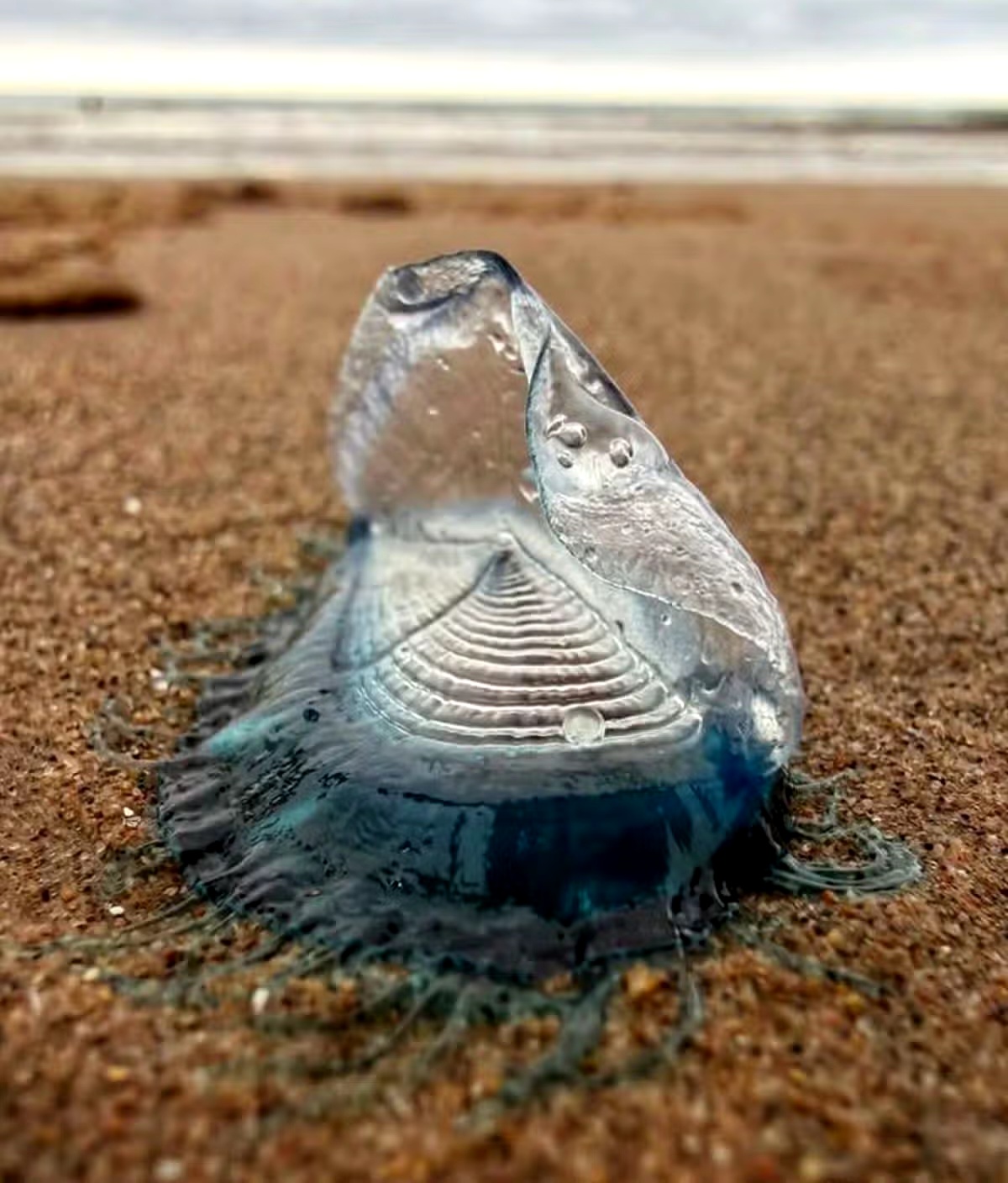
Hundreds of striking blue marine creatures have washed ashore on a beach in northwest England, surprising visitors and sparking curiosity among locals.
The unusual creatures appeared along St Bees Beach in Cumbria, where beachgoers initially mistook them for jellyfish or an unfamiliar type of seaweed before experts identified them as “by-the-wind sailors,” scientifically known as Velella velella.
Despite their jellyfish-like appearance, by-the-wind sailors are not true jellyfish. They are colonial hydrozoans closely related to the Portuguese man o’ war but are much smaller and are generally regarded as harmless to humans.
Experts, however, advise people not to handle them because they possess short stinging tentacles used to capture tiny fish and plankton.
The creatures get their distinctive name from a small, transparent sail-like fin that protrudes above the water’s surface, allowing winds and ocean currents to carry them across the sea.
Local resident Louise Nicholson discovered the unusual sight while spending the day at the beach. She initially thought the blue objects were an uncommon species of seaweed and nearly picked one up before deciding to photograph them instead.
“There were hundreds of them and there were lots of visitors to the area taking photos,” she said.
“They are absolutely beautiful, only about five centimetres in size. It was a great find on a beautiful day.”
Nicholson later shared the photographs with the Cumbria Wildlife Trust, which confirmed the creatures’ identity.
According to the trust, by-the-wind sailors spend their lives drifting across the ocean, propelled by wind rather than active swimming.
The organisation explained that each individual is not a single animal but a colony of specialised polyps functioning together as one organism. Different polyps perform specific roles, including feeding, reproduction and defence.
Marine experts believe the creatures were likely carried to the Cumbrian coastline by warm Atlantic waters and favourable winds.
The species is most commonly observed along the coastlines of Britain and Ireland during autumn and winter, when storms and strong winds push large numbers ashore. Their appearance during calmer periods is less common, making sightings such as those at St Bees particularly eye-catching.