






















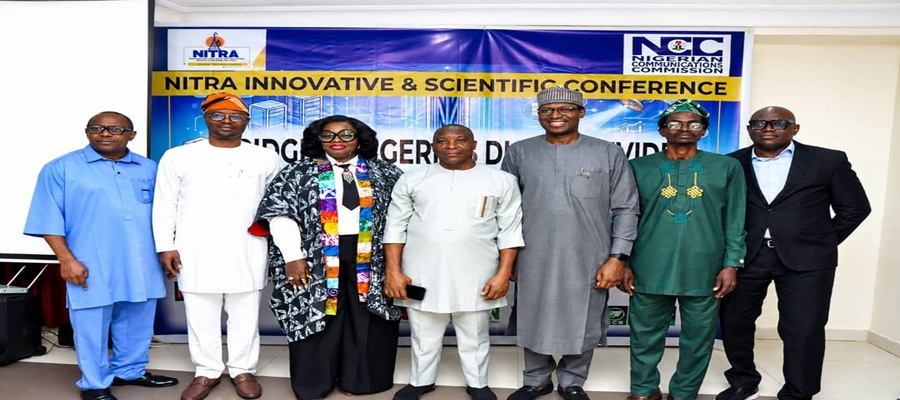
Stakeholders in Nigeria’s information and communications technology (ICT) sector have called for comprehensive policy reforms, stronger infrastructure investment and grassroots innovation to bridge the country’s digital divide and improve global competitiveness.

NITRA Conference
The stakeholders made the call on Thursday during the Nigeria Information Technology Reporters Association (NITRA) Innovative and Scientific Conference held at Citi Height Hotel, Ikeja, Lagos.
The conference, themed “Bridging Nigeria’s Digital Divide With Scientific Innovation,” brought together government agencies, technology experts, regulators, telecom operators, private sector players, academics and policymakers to examine strategies for accelerating digital inclusion through science and innovation.
A panel session titled “The Place of Policy and Infrastructure in Nigeria’s Quest for Global Competitiveness through Scientific Innovation: Roles of Different Stakeholders in Grassroots Mobilisation” examined the policy, infrastructure and human capital requirements for driving Nigeria’s digital transformation.
Panelists identified multiple taxation, high right-of-way (RoW) charges, inconsistent state government policies, poor electricity supply, inadequate digital infrastructure and limited grassroots innovation support as major impediments to expanding broadband access and improving Nigeria’s competitiveness in the global digital economy.
One of the speakers noted that transporting internet bandwidth from Lagos to Canada is cheaper than extending connectivity to some parts of Nigeria because of infrastructure bottlenecks and multiple charges imposed by sub-national governments.
According to the panelist, although some state governments claim to have abolished right-of-way charges, operators are still subjected to numerous levies under different names.
“When we talk about right-of-way limitation, it affects the cost of providing services in some states.
“Some states say right of way is free, but when they grant free right of way, they introduce development charges, education levies and infrastructure fees, making the so-called free right of way meaningless,” the panelist said.
The speaker called for harmonised national policies that would eliminate multiple taxation and reduce the cost of deploying telecommunications infrastructure across the country.
Another panelist representing telecommunications operators stressed that government policies should encourage fair competition rather than favour dominant market players.
According to the representative, improved collaboration between regulators and industry operators is necessary to ensure that policies support innovation, cybersecurity and sustainable sector growth.
Speaking on innovation development, a representative of a private sector innovation fund said Nigeria must begin identifying and nurturing innovators from an early age.
The representative said the organisation supports young innovators through essay competitions, grants and educational programmes aimed at exposing students to science, technology and entrepreneurship.
“We believe innovation begins from childhood.
“By helping children in primary and secondary schools think creatively, they become better positioned to seize opportunities as they grow.
“Innovators exist everywhere, including rural communities. What many of them need is exposure and opportunity,” the speaker said.
On cybersecurity, another panelist advocated greater investment in developing indigenous cybersecurity professionals through structured internship and mentorship programmes.
The panelist also suggested that young people involved in cybercrime should, where appropriate, be rehabilitated and equipped with legitimate digital skills rather than relying solely on imprisonment.
“Part of what we are known for is developing local talent.
“We recruit interns from schools and train them in cybersecurity.
“We should find ways to harness the abilities of young cyber offenders instead of simply sending them to prison,” the speaker said.
A representative from the computer society sector emphasised that Nigeria’s digital transformation should begin with reforms in basic education.
According to the representative, pupils should be introduced to coding, robotics, artificial intelligence and innovation at the primary school level.
“If Nigeria wants to become globally competitive, we must start from primary school.
“Our schools should not merely prepare students for examinations; they should become innovation clubs where children learn robotics, coding and problem-solving,” the panelist said.
The speaker also referenced the recent launch of an artificial intelligence university portal in Lagos designed to create a talent pipeline from primary education through tertiary institutions.
Addressing regulation, a media analyst cautioned against excessive government control that could discourage technological innovation.
According to the analyst, regulatory frameworks should emerge through stakeholder engagement and strike a balance between consumer protection and innovation.
“Regulation must come with dialogue.
“If regulation becomes excessive, it will stifle innovation.
“As Nigeria develops policies on artificial intelligence, there is a need to strike the right balance,” the analyst said.
On infrastructure protection, another panelist called for stronger public awareness campaigns to discourage vandalism of telecommunications infrastructure.
The speaker said community ownership and public education are essential to safeguarding digital infrastructure.
“When telecommunications infrastructure is vandalised, everyone suffers, including regulators, operators and consumers.
“People need to understand that protecting infrastructure benefits the entire society,” the panelist said.
Participants also highlighted the affordability of digital services as a major challenge to digital inclusion.
One speaker urged the Federal Government to consider subsidy mechanisms that could reduce the cost of internet-enabled devices.
“Telecommunications companies are businesses, not charity organisations.
“If government introduces subsidy policies similar to what has been done in other sectors, device prices can become more affordable,” the speaker said.
Another panelist stressed that reliable electricity remains fundamental to Nigeria’s digital competitiveness.
“The child who enjoys uninterrupted electricity and internet access cannot be compared with one who has gone months without power.
“For Nigeria to compete globally, every child should have reliable electricity, internet access and opportunities to acquire digital skills,” the speaker added.
Earlier, NITRA Chairman, Mr Chike Onwuegbuchi, said the conference was organised to provide a platform for stakeholders to examine policy options capable of strengthening scientific innovation and promoting grassroots technological development.
He noted that the Federal Government had demonstrated increasing commitment to building an innovation-driven economy through various strategic initiatives.
Founded in 2013, NITRA is the umbrella body of journalists covering Nigeria’s information and communications technology sector.