




























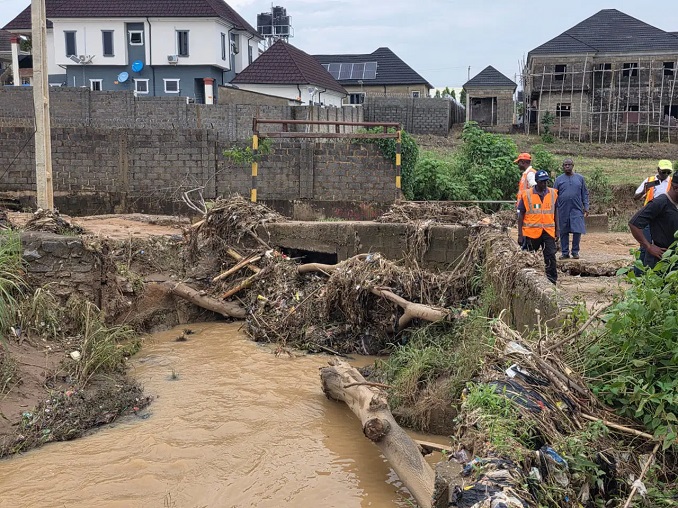
The Federal Capital Development Authority (FCDA) has attributed the recent flooding in parts of Abuja to heavy rainfall, blocked drainage systems and human activities, including the dumping of refuse in waterways.
The Acting Executive Secretary of the FCDA, Richard Dauda, disclosed this on Thursday during an inspection tour of some flood-affected areas in the Federal Capital Territory.
Dauda said weather forecasts had predicted heavy rainfall this year, while climate change had also increased the risk of torrential rain and flash floods.
He noted that Abuja’s vulnerability to flooding was already recognised in the city’s Master Plan because of its geographical location.
According to him, although resilient infrastructure had been provided in several parts of the capital, some drainage facilities had become heavily silted over time.
He cited the Airport Road as an example, saying drainage channels along the corridor were being desilted following a directive from the FCT Minister, Nyesom Wike.
“The desilting is already ongoing so that when the rains fall again, we won’t have a similar experience,” Dauda said.
He, however, identified indiscriminate dumping of refuse into drainage channels as one of the major human factors worsening flooding in the city.
According to him, rainfall carries waste and other objects into drainage systems, where they can block outlets and prevent water from flowing properly.
“When rain falls, it washes them down, and in some cases, you see large objects. These large objects, when they get to the outlets, they block it,” he explained.
Dauda urged residents to stop dumping refuse into waterways, warning that such practices contribute significantly to flash floods.
He also highlighted the impact of illegal construction on natural waterways.
According to the FCDA chief, a stream running from Galadima Roundabout and crossing the Airport Expressway through a triple-cell box culvert had been constricted downstream after a developer built retaining walls to gain additional land.
He explained that the obstruction had reduced the volume of water that could pass through the channel, resulting in detention, backflow and eventual flooding.
Dauda said the structure would have to be removed to restore the waterway to its appropriate width and ensure adequate water discharge.
FCDA Targets Vandalised Drainage Covers
The acting executive secretary also raised concerns over the vandalism of gully covers designed to prevent debris from entering drainage systems.
He said the theft of the covers in some locations had allowed refuse and other materials to flow directly into the gullies, further contributing to blockages.
Dauda criticised those responsible for vandalising public infrastructure, noting that the facilities were funded through public resources.
He disclosed that the FCDA was considering replacing the stolen covers with non-recyclable materials instead of steel and cast iron to discourage further theft.
He added that the FCT Minister had directed relevant agencies to commence comprehensive desilting across the territory.
The exercise will cover trapezoidal drains, U-channels along roads and culverts, while new drainage structures will be constructed where necessary.
Dauda said Thursday’s inspection was aimed at assessing the extent of the flooding and monitoring compliance with the minister’s directive on desilting.
He added that work was already ongoing on trapezoidal drains along the expressway, with affected outlets along the Airport Road also scheduled for attention.