



























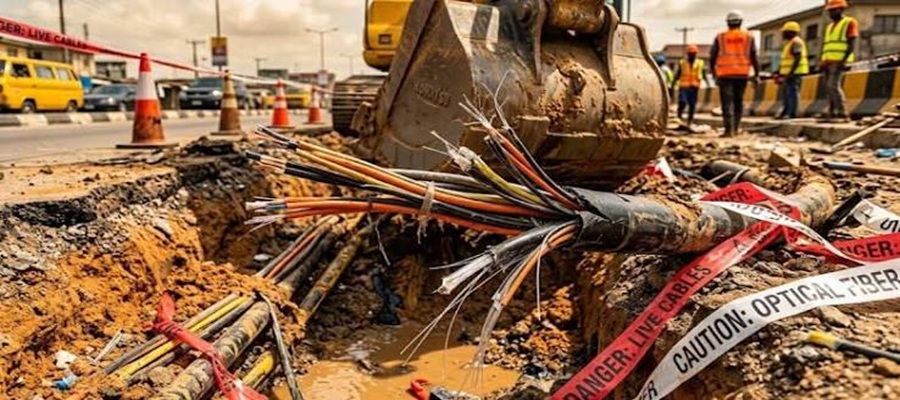
Nigeria’s telecommunications industry recorded 155,397 fibre-cut incidents between April and May 2026, a development that continues to disrupt internet and voice services across the country.
Fibre Cuts
Data from the Nigerian Communications Commission (NCC) showed that fibre-cut incidents rose from 74,276 in April to a record 79,121 in May, bringing the two-month total to the highest level recorded by the industry.
The figure represents a sharp increase from the 5,934 incidents reported in the first quarter of 2026.
Industry stakeholders attribute the persistent service disruptions to widespread vandalism, road construction activities and delays in repairing damaged infrastructure.
According to the data, vandalism remained the leading cause of fibre cuts, accounting for more than 54,000 incidents during the period, despite the designation of telecommunications infrastructure as Critical National Information Infrastructure (CNII).
The classification is intended to strengthen the protection of critical digital assets and prescribes penalties of up to 10 years’ imprisonment for offenders found guilty of vandalising such infrastructure.
Road construction activities also continue to contribute significantly to the problem, as excavation equipment frequently damages underground fibre-optic cables during road rehabilitation and expansion projects.
Telecommunications operators have also expressed concerns over regulatory bottlenecks in some states, citing multiple taxes, levies and right-of-way challenges that slow down the restoration of damaged fibre infrastructure.
The recurring fibre cuts have continued to affect the quality and reliability of telecommunications services, resulting in network outages, slow internet speeds and interrupted voice calls for millions of subscribers.
To address the challenge, the NCC is developing a cost-based framework for shared underground duct infrastructure to minimise repeated excavation and protect fibre-optic cables.
Operators are also exploring the deployment of Artificial Intelligence-powered fibre sensing technologies capable of detecting cable damage in real time, enabling faster response and improved network resilience.
In addition, stakeholders have continued to advocate the nationwide implementation of the Dig-Once Policy, which promotes the installation of shared underground ducts during road construction to reduce repeated excavation and lower infrastructure deployment costs.
Nigeria is pursuing ambitious broadband expansion targets under the National Broadband Plan and has expanded its fibre-optic network to about 35,000 kilometres.
However, industry experts warn that unless infrastructure protection keeps pace with network expansion, subscribers will continue to experience service disruptions despite sustained investment by telecommunications operators.
The stakeholders stressed the need for stronger collaboration among federal and state governments, road construction agencies, security agencies and telecom operators to safeguard critical communications infrastructure and support the country’s digital economy goals.