

























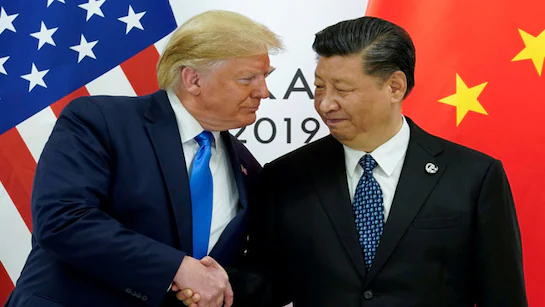
The worlds biggest economies, United States and China have agreed to extend their trade truce for another 90 days, just hours before higher tariffs were due to take effect.
On Monday, August 11, U.S. President Donald Trump signed an executive order continuing the pause until 10 November, while Beijing announced a parallel extension. Under the deal, U.S. tariffs on Chinese goods will remain at 30%, and China will maintain its 10% levy on American imports.
Earlier this year, Washington had threatened tariffs of up to 145% on Chinese products, while Beijing planned duties as high as 125% on U.S. shipments. Both sides scaled back after trade talks in Geneva in May.
The White House said the extension allows more time to address “trade imbalances” and “unfair trade practices,” pointing to a nearly $300bn U.S. trade deficit with China in 2024 — the largest with any trading partner.
Talks will also cover: Greater market access for U.S. exporters, National security and economic concerns and Stability in global semiconductor supply
A spokesperson for the Chinese embassy in Washington said, “Win-win cooperation between China and the United States is the right path; suppression and containment will lead nowhere.” Beijing urged the U.S. to remove “unreasonable” trade restrictions.
While the move averts an immediate escalation, some U.S. business owners say uncertainty persists.
“There’s no way to plan for the future of the business,” said Beth Benike, founder of Busy Baby. “I have no control or idea about the pricing that’s going to work for my business.”
Trade tensions peaked in April when Trump imposed sweeping tariffs on multiple countries, with China among the hardest hit. Beijing retaliated, nearly freezing trade flows before the May agreement eased some measures.
Ongoing discussions include: Access to China’s rare earth minerals, Chinese purchases of Russian oil, U.S. export curbs on advanced technology, including semiconductors
Recently, Washington loosened certain restrictions, allowing companies like AMD and Nvidia to sell some chips to China in exchange for a 15% revenue share with the U.S. government. The U.S. is also pressing for TikTok’s separation from its Chinese owner ByteDance, a move Beijing opposes.
Even with the truce, bilateral trade has weakened. In June, U.S. imports from China were nearly 50% lower than the same month in 2024. For the first half of 2025, imports totaled $165bn — down 15% year-on-year — while U.S. exports to China fell 20%.