























Lagos State Governor, Babajide Sanwo-Olu, has warned “residents and developers against building on wetlands and drainage channels,” saying their “destruction increases the state’s vulnerability to flooding and coastal erosion.”
Sanwo-Olu spoke on Saturday at the Nigerian Conservation Foundation’s 20th annual Walk for Nature at Makanjuola Hall, Lagos State University, Ojo, where he outlined measures to address climate change and environmental degradation.
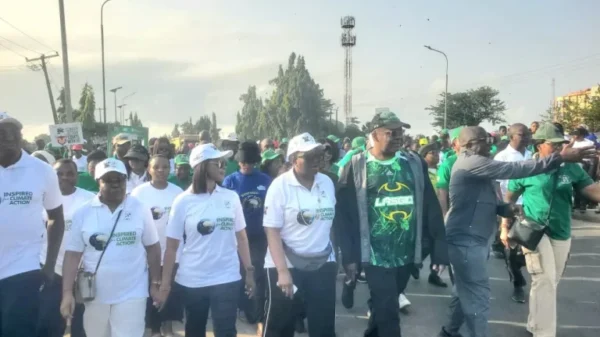
The event, themed “Inspired for Climate Action,” featured a road walk from the LASU campus in Ojo to Iyana School Bus Stop along the LASU-Isheri Road.
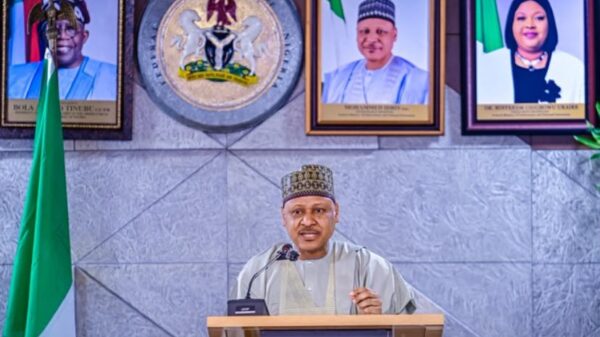
Represented by the Permanent Secretary, Office of Environmental Services, in the Ministry of the Environment and Water Resources, Dr Gaji Tajudeen, Sanwo-Olu said Lagos’s coastal location, low-lying terrain and growing population made wetland protection critical to public safety.
“Our wetlands, mangroves and lagoons are our first line of defence against floods and coastal erosion. Where they are filled or built over, water has nowhere to go, and gravity exacts the price,” the governor said.
Sanwo-Olu said the state had banned styrofoam and other single-use plastics, adding that enforcement had been ongoing since July 2025 as part of its environmental sustainability efforts.
He said the government was also working with innovators to develop sustainable alternatives and promote environmental education in schools and communities.
On wetland protection, the governor disclosed that the government suspended reclamation activities affecting wetlands, floodplains and lagoon fronts in September 2025 where the required environmental impact assessments and other approvals had not been obtained.
Make PUNCH part of your everyday experience.
Add us to your Preferred Sources
“Our position is simple. Development in Lagos must pass the test of drainage and environmental approval, including the necessary environmental impact assessments and approvals,” he said.
He added that the government was investing in drainage infrastructure, restoring mangroves, planting trees and developing parks to strengthen the state’s natural defences against flooding and rising temperatures.
Sanwo-Olu urged residents to keep refuse out of drains, avoid single-use plastics and refrain from building on wetlands and drainage channels.
He encouraged young people to separate their waste, plant trees and promote environmental responsibility in their hostels, on campus and in surrounding communities.
The governor commended the NCF for sustaining its environmental advocacy over two decades, saying the next 20 years should produce measurable results.
“Twenty years of working has built awareness; the next 20 must deliver results,” he said.
Recall that earlier in October, Magodo Phase II Residents Association called on Sanwo-Olu to halt what it described as an unauthorised attempt by developers to construct link roads through the estate to access a protected wetland.
The association said a number of articulated trucks and heavy-duty equipment had been stationed outside the Shangisha Gate, raising concerns about a possible forceful entry into the estate.
Meanwhile, the Chairman of the NCF National Executive Council, Hon. Justice R.I.B. Adebiyi, said Lagos was at the forefront of Nigeria’s climate vulnerability, with rising sea levels, flooding, extreme heat and wetland loss threatening communities and livelihoods.
Adebiyi said nature conservation was essential to the city’s survival and should not be treated as separate from urban development.
“Our wetlands, our forests, our waterways, our green spaces—they are not luxuries; they are infrastructure that we need to keep Lagos liveable,” she said.
She cited the Lekki Conservation Centre as an example of how a functioning natural ecosystem could be preserved within a rapidly growing city.
“The lesson is simple: when we protect nature, we protect people. When we destroy nature, we weaken the very system that helps our communities withstand climate shocks,” she said.
Adebiyi also urged governments to integrate climate action into land-use planning, flood management, urban development and environmental governance.
“The climate crisis is a test of our responsibility, our creativity, our courage and our humanity,” she said, warning that future generations would live with the consequences of decisions made today.
In his remarks, the Vice-Chancellor of Lagos State University, Prof. Ayodeji Badejo, represented by a Senior Deputy Bursar, Jerry Jinadu, described the Walk for Nature as an initiative promoting physical fitness, social connections and environmental sustainability.
“Walk for Nature is more than a physical exercise. It is a movement that promotes fitness, strengthens social relationships, encourages environmental awareness, and reminds us of our collective responsibility to protect the nation’s natural environment,” he said.