





























Nigerian Communications Commission (NCC) has approved the transfer of a 10MHz spectrum in the 2.6GHz spectrum band from OPENSKYS Services Limited (OS) to MTN Nigeria.
According to a statement from MTN, the licence took effect on September 7, 2023, and will see MTN deploy the spectrum across the 36 states of the federation, including the FCT.
The 2.6GHz spectrum band is designated for the deployment of terrestrial mobile broadband services. According to a GSMA report on opportunities for global mobile broadband, the 2.6GHz spectrum band is the ideal complement to the 700MHz-800MHz spectrum bands as together, these bands can help to provide the most cost-effective nationwide coverage of mobile broadband services across both rural and urban areas.
Broadband penetration in Nigeria stood at 47.36 per cent as at December 2022. The Federal Government of Nigeria has a target of 70 per cent broadband penetration by 2025.
MTN Nigeria’s acquisition of the broadband spectrum will enable the ICT giant to provide improved broadband services for its customers, meeting the rapidly growing demand for capacity to deliver mobile broadband services on a widespread, common basis across the country.
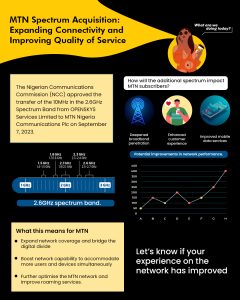
MTN says the transfer of the spectrum will significantly improve its customers’ experience in line with its commitment to deliver excellent service.
In addition, the acquired spectrum will also enable the telecommunications operator to deliver broadband technologies, aiding the achievement of Nigeria’s broadband objective.
Commenting on the acquisition, Karl Toriola, Chief Executive Officer, MTN Nigeria said, “This additional spectrum will enable us to deliver on our promise to our customers to deliver quality service, as we continue to support the Federal Government’s vision of deepening broadband penetration in the country.”
A report by the GSMA suggests that an increase in broadband penetration especially in developing countries automatically translates to an increase in Gross Domestic Product (GDP) and this underscores the need for constant development and investment in broadband infrastructure such as the 2.6GHz spectrum band.