

























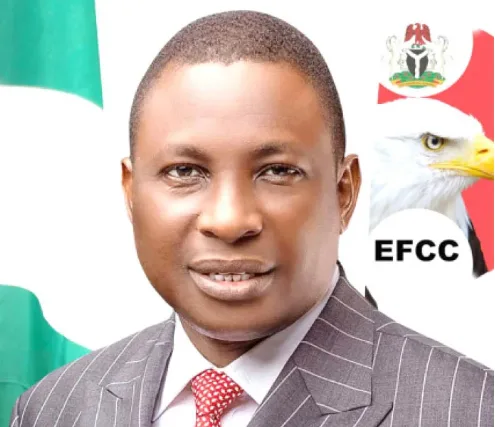
The Economic and Financial Crimes Commission (EFCC) recovered more than N1.23tn and $684.47m in proceeds of crime and secured 10,872 convictions during the first 34 months of Ola Olukoyede’s tenure as chairman.
Olukoyede disclosed the figures on Monday while presenting his three-year stewardship report at the EFCC headquarters in Abuja.
According to the EFCC chairman, the commission received 49,673 petitions between October 2023 and July 2026. Of these, 39,615 cases were investigated, while 14,476 cases were filed in court, resulting in 10,872 convictions.
He said the figures represented a 75.1 per cent conviction-to-filing ratio.
Olukoyede added that the commission secured 1,370 convictions from 1,889 court filings during the first half of 2026.
He attributed the results to a prosecutorial approach centred on thorough investigations, evidence gathering and successful courtroom outcomes.
“Our approach has been anchored on properly focusing our mandate in the overall interest of Nigerians, using the anti-graft war to stimulate economic growth, strengthen the rule of law, improve transactional credibility, enhance Nigeria’s image and attract foreign direct investment,” he said.
EFCC Recovery Figures
Olukoyede said that between October 1, 2023 and June 30, 2026, the EFCC recovered:
- N1,233,612,040,411.11
- $684,478,457.32
- £373,905.78
- €9,343,803.66
Of the naira recoveries, about N397.26bn, or 33 per cent, represented direct recoveries for the Federal Government.
The remaining N836.34bn, or 67 per cent, comprised indirect recoveries made on behalf of ministries, departments and agencies, state revenue services, companies, individuals and foreign victims.
Olukoyede said the figures meant that roughly two out of every three naira recovered by the commission were recovered for beneficiaries other than the Federal Government.
“Recovery is only meaningful when the value is ultimately returned to the public interest or rightful beneficiaries,” he said.
The EFCC chairman disclosed that N661.32bn and $492.37m had been released to beneficiaries during the period under review.
Of the naira disbursements, N325.35bn was paid directly to individuals and corporate bodies, while N335.97bn went to government ministries, departments and agencies, the Nigerian Revenue Service, state internal revenue services, public institutions, companies and individuals.
More Than 40 EFCC Officers Dismissed
Olukoyede also revealed that more than 40 EFCC personnel had been dismissed for corruption and financial malpractice during his tenure.
More than five of the affected officers are currently facing prosecution, he said.
According to the EFCC chairman, the commission must maintain strict internal accountability if it is to effectively fight corruption in the wider society.
“You can’t be fighting corruption when your hands are soiled with corrupt practices,” Olukoyede said.
The commission has also renamed its former Internal Affairs Department as the Department of Ethics and Integrity and introduced policies covering gifts and hospitality, conflicts of interest and exhibit-room security.
Cybercrime, Fraud and Other Financial Crimes
Olukoyede said the EFCC recorded 46,288 offences across nine major crime categories between 2024 and 2026 year-to-date.
Advance fee fraud and cybercrime accounted for nearly two-thirds of the offences recorded.
He said the number of recorded offences increased by 24.1 per cent between 2024 and 2025, with notable increases in procurement fraud, bank fraud, cybercrime and economic-governance offences.
The EFCC has also stepped up enforcement against money laundering, unlicensed bureaux de change, illegal mining, virtual assets and terrorist financing.
Olukoyede said 920 specialised cases resulted in 212 convictions, while other investigations and prosecutions remain ongoing.
The commission recorded 234 cases involving bureaux de change and secured 73 convictions during the period.
He said the enforcement of unlicensed BDC operations complemented Central Bank of Nigeria reforms aimed at creating a more formal and transparent retail foreign-exchange market and shutting channels vulnerable to illicit finance, speculation and round-tripping.
EFCC Recovers Tax Revenue
The commission’s enforcement activities also generated approximately N288.1bn in federal and state tax recoveries.
Of that amount, N173.2bn represented federal tax recoveries, while N114.9bn was attributed to state internal revenue services.
Olukoyede stressed that the recoveries represented enforcement of existing tax obligations rather than the introduction of new taxes.
The commission also recorded about N257.2bn in naira recoveries for federal ministries, departments and agencies.
10,053 Assets Forfeited
Beyond cash recoveries, the EFCC secured forfeiture orders covering 10,053 tangible assets between October 2023 and July 2026.
The assets included:
- 8,198 electronic items
- 1,177 real estate properties
- 370 automobiles
- 251 plots of land
Other forfeited assets included schools, factories, hotels, shops, oil rigs, barges, machinery and aircraft. The commission also secured the forfeiture of 102 tonnes of solid minerals.
Olukoyede said proceeds from the disposal of assets under final forfeiture orders amounted to approximately N12.07bn, which was paid into the Federal Government’s coffers.
Recovered Assets Put to Public Use
Olukoyede highlighted the social impact of recovered assets, citing the conversion of NOK University in Kachia, Kaduna State, into the Federal University of Applied Sciences, Kachia.
He said the institution, recovered through the EFCC’s asset-forfeiture process, had 1,909 students matriculate in December 2025.
The EFCC chairman also disclosed that the Federal Government allocated N50bn each from EFCC recoveries to the Nigerian Education Loan Fund and the Nigerian Consumer Credit Corporation in 2024, with another N50bn allocation to each institution approved in 2026.
He said the use of recovered criminal proceeds for education and household credit demonstrated a shift from viewing anti-corruption enforcement solely as punishment to using it to restore stolen value and support national development.
Nigeria’s Anti-Money Laundering Efforts
Olukoyede linked the EFCC’s enforcement activities to Nigeria’s broader efforts to strengthen its anti-money laundering and counter-financing of terrorism framework.
He described Nigeria’s removal from the Financial Action Task Force Grey List in October 2025 as a major national achievement and said the EFCC’s investigations and enforcement work contributed to strengthening the country’s compliance framework.
He also credited collaboration with domestic and international law-enforcement agencies and regulators, including the US Federal Bureau of Investigation, UK National Crime Agency, Royal Canadian Mounted Police and INTERPOL.
EFCC Digitalises 60% of Operations
As part of its reform programme, the commission has digitalised approximately 60 per cent of its processes and operations, Olukoyede said.
The EFCC has introduced new guidelines on arrest and bail, reviewed its sting operations and established specialised units, including the Department of Fraud Risk Assessment and Control and the Cybercrime Rapid Response Centre.
The commission has also inaugurated directorates in Enugu and Ilorin, while establishing new directorates in Ekiti, Anambra and Katsina states.
Olukoyede said the EFCC’s performance should not be measured simply by the number of arrests or amount of money recovered.
He said the commission’s broader objective was to transform intelligence into prevention, petitions into investigations, investigations into prosecutions, prosecutions into convictions and recoveries into restitution.
“The ultimate objective is to turn enforcement into measurable national value,” he said.
The EFCC chairman pledged that the commission would continue its fight against corruption and economic crimes while maintaining due process and focusing on outcomes that deliver measurable value to Nigerians.