

























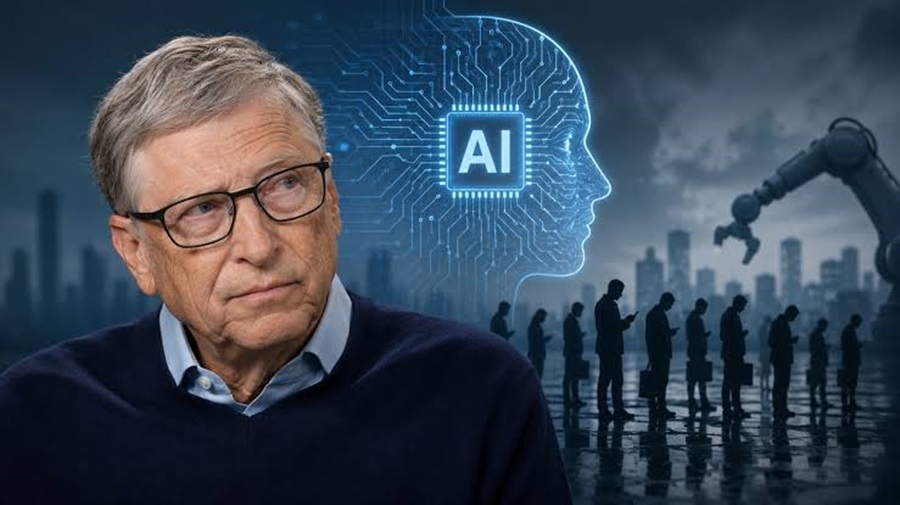
Microsoft co-founder Bill Gates has warned that the world is not prepared for the massive disruption artificial intelligence (AI) could bring, including the loss of millions of jobs, with young people likely to be among the hardest hit.
Gates said the world must begin preparing for a period of rapid change driven by AI, which could reshape jobs, governments, businesses and even human relationships.
In his latest blog post, titled “The turbulent AI era is here. The choices we make now are critical,” Gates examined the potential benefits and risks of the fast-growing technology.
He described the transition to the AI era as one of the most turbulent periods in human history.
While acknowledging AI’s enormous potential to improve human life — from supporting doctors and teachers to improving agriculture and government services — Gates warned that society is not adequately prepared for the scale of disruption the technology could bring.
According to Gates, the AI transition comes with three major risks, with job displacement being the first.
He warned that AI would not affect only one sector but could increasingly perform tasks across industries such as law, customer service, medicine, software engineering and manufacturing.
“It will hit these industries rapidly, over the course of a decade rather than a few generations,” Gates wrote.
He said entry-level and mid-level jobs could be particularly vulnerable in an AI-driven economy, while many of the new roles created by the technology would require advanced skills that could take years to acquire.
Gates said AI could affect a broad range of occupations, including sales and customer support, software engineering, paralegal work, law, medicine and manufacturing.
“There will be some new jobs, but without the right policies there will be far fewer than exist today,” he wrote.
The impact, he added, would not be limited to white-collar workers.
“I think ‘smart’ robots will begin to compete with people on some physical tasks — in the construction and hospitality industries, for example — by the end of the decade,” Gates said.
He expressed particular concern about the speed of the transition, warning that the changes could happen within a decade rather than gradually over several generations.
Gates said he was especially worried about young people entering the workforce at a time when AI could significantly reduce the number of entry-level opportunities.
“I’m especially worried about young people, who will enter a workforce with fewer entry-level openings,” he said.
According to him, the decline in entry-level roles could make it more difficult for young workers to gain practical experience and learn from older colleagues.
“That means they’ll have fewer opportunities to gain experience and learn from older workers,” Gates added.
The billionaire philanthropist’s warning adds to growing global concerns over how governments, businesses and educational institutions can prepare workers for an economy increasingly shaped by artificial intelligence.