






















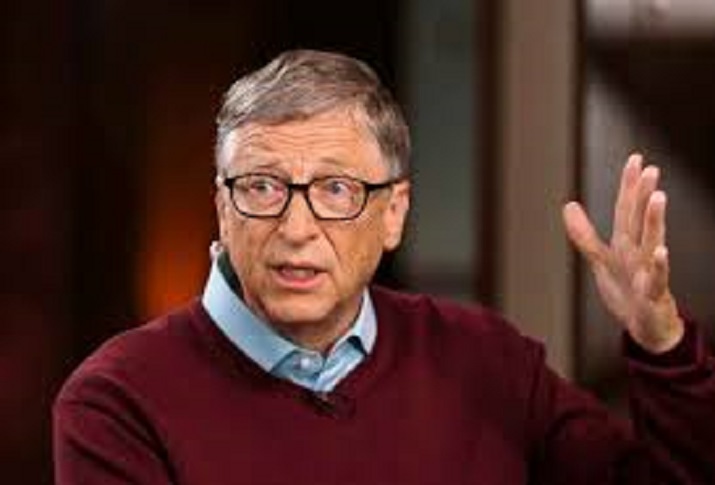
Bill Gates has called on governments to take urgent action to manage the economic and social disruption that could result from the rapid development of artificial intelligence (AI).
The Microsoft co-founder said AI could either become a major force for reducing inequality or deepen existing social and economic disparities, depending on the policies governments adopt.
Gates made the call in a roughly 6,000-word essay published on his Gates Notes website, in which he outlined concerns about the speed at which AI could transform the labour market.
He also proposed measures aimed at reducing the potential impact of automation on workers.
One of his key proposals is a new tax on AI, which he described as a “token tax”.
According to Gates, the current tax system could encourage companies to replace human workers with machines because businesses pay payroll taxes on employees, while spending on AI systems can be treated as a business expense.
“The tax system nudges you toward replacing people with machines,” Gates said.
He argued that an AI-specific tax, alongside his previously proposed tax on robots, could help slow the impact of automation on employment while generating revenue for worker retraining and stronger social safety nets.
Gates said such a tax system could also be structured to avoid discouraging beneficial applications of AI, including efforts to make healthcare and education more affordable.
The billionaire philanthropist also proposed the creation of “Human Reserved” jobs, which would deliberately remain the preserve of people even when machines become technically capable of performing them.
He said some jobs might need to remain reserved for humans because widespread automation could create severe economic disruption for workers who may find it difficult to change careers.
“We might set something aside as Human Reserved for economic reasons. For example, we may do it because allowing machines to take over a certain role will displace a large number of people who can’t easily change jobs,” Gates said.
He cited the example of an older construction worker who might struggle to find fulfilment after being forced to switch to an entirely different profession.
Gates said some jobs should also remain human for reasons beyond economics, particularly roles involving care, empathy and deeply personal interactions.
“Sometimes the decision to make something Human Reserved will be driven by other factors,” he said.
He cited healthcare as an example, arguing that while a robot might technically be capable of delivering difficult medical news to a patient, society may decide that such an interaction should remain human.
Gates also referred to his personal experience with caregiving following his father’s battle with Alzheimer’s disease.
He said his father received round-the-clock care before his death in 2020 and argued that aspects of the care provided were “irreplaceably human”.
The proposals come amid growing concerns about AI-driven job losses as companies increasingly deploy the technology across different industries.
Gates said the transition to AI could occur much faster than previous technological transformations because the technology can be integrated into existing computers, smartphones, software platforms and business systems.
He contrasted AI with the personal computer revolution, which took decades to fundamentally reshape workplaces and everyday life.
According to him, many entry-level and mid-level jobs could be affected before workers, governments and institutions have sufficient time to adjust.
Gates said the key question was not simply whether AI was good or bad but who would benefit from the technology and who would bear the economic costs of its disruption.
He remains optimistic about AI’s potential to improve healthcare, education, agriculture, scientific research, government services and small businesses.
However, he warned that the benefits could be concentrated among people and countries that already possess significant wealth and power, while vulnerable communities and displaced workers bear the consequences.
Gates called on governments to intervene before the effects of the AI transition become too difficult to manage.
He proposed the creation of new national and international institutions to oversee the transition, alongside changes to tax rules and the establishment of Human Reserved jobs where necessary.
He acknowledged that deciding which jobs should remain exclusively human would be difficult.
Gates said that while robots might eventually become capable of building houses, widespread automation could raise serious questions about the future of skilled construction workers.
Similarly, he said AI might be able to provide information efficiently but that did not necessarily mean it should replace teachers who provide motivation, empathy and personal support.
The Microsoft co-founder argued that technological capability should not automatically determine what society chooses to automate.
He said the risk of a net-negative outcome from the AI transition was currently “very high”, particularly if technological development continues to move faster than governments, workers and institutions can adapt.
Gates expects significant disruption across medicine, law, middle management and manufacturing over the next decade, as well as in sales, customer service and software engineering.
He also expressed concern about young people entering the workforce, warning that AI could eliminate many entry-level tasks and reduce opportunities for workers to gain the experience needed to progress in their careers.
Gates said the scale of the challenge required what he described as an unprecedented global response.
He called for a domestic and international framework for managing the AI transition, adding that the process should involve elected officials, policymakers, educators, healthcare workers, local authorities and community leaders.
According to him, the decisions made now will determine whether AI becomes a force that improves lives broadly or deepens existing inequalities.