






















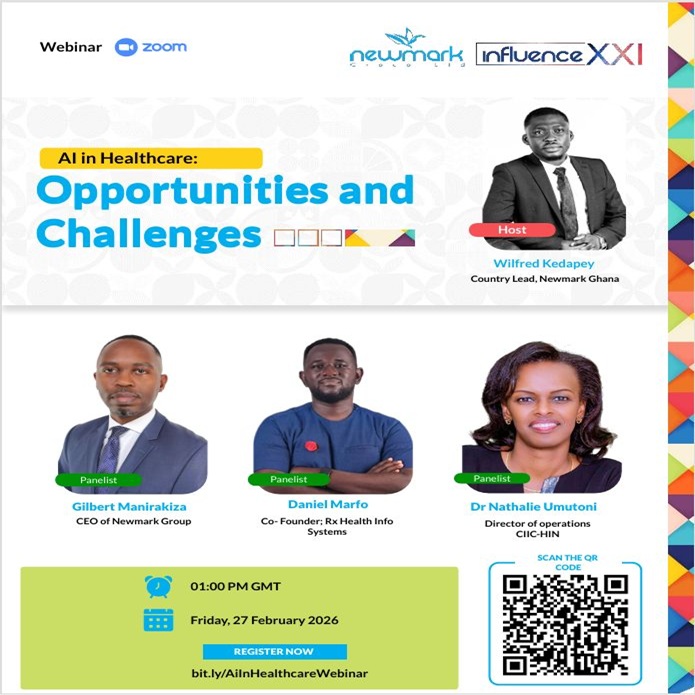
A recent webinar hosted by the Newmark Group examined how Artificial Intelligence AI is changing healthcare across Africa, highlighting both its promise and its risks.
Newmark Webinar
The session, titled “AI in Healthcare: Opportunities and Challenges,” brought together healthcare and communications experts who agreed that AI can help fix long-standing problems in Africa’s health systems — but only if it is used carefully and responsibly.
Gilbert Manirakiza, CEO of Newmark Group in his opening speech said that AI is already helping speed up decision-making. He said AI tools can quickly analyse patient feedback, monitor conversations online, personalise health messages for different audiences and reduce delays in approvals.
He noted that many patients now turn to AI tools like ChatGPT to ask about symptoms and treatments. Because of this, he said health communicators must take responsibility for ensuring accurate information is available.
“If AI makes mistakes in healthcare, the consequences affect real lives,” he said.
Manirakiza stressed that Africa’s healthcare environment is unique. Many communities rely on mobile phones, speak different local languages and trust religious or community leaders. He warned that AI systems built mainly with Western data may misunderstand African realities.
He summarised his position simply: AI should help speed up work, but humans must ensure accuracy.
Daniel Marfo spoke about how AI is already being used in practical ways. Insurance companies now use AI systems to process thousands of claims daily. In hospitals, electronic medical records can suggest possible diagnoses and help doctors decide which patients need urgent attention.
He also said AI tools are helping detect problems in X-rays and MRI scans faster, especially in places where there are few radiologists. This reduces waiting time for patients.
At a national level, countries such as Rwanda, Sierra Leone and Ghana are building health data centres powered by AI to help governments track diseases and plan better responses.
However, Marfo warned that AI tools must be built using local medical guidelines to gain doctors’ trust. He emphasised that AI should support doctors, not replace them.
Dr. Afriyie Bempah focused on how AI can help countries prepare for health crises before they happen. He said resilience is not just about recovering from shocks, but about predicting them early.
He cited examples such as Kenya using AI to track mosquito patterns to predict malaria outbreaks, and Ghana using digital tools to improve disease reporting. In South Africa, digital health systems have been adapted to manage patients with chronic illnesses remotely.
He explained that linking clinics, pharmacies and supply chains through data sharing can help detect disease trends early and prevent large outbreaks.
During the question session, speakers discussed challenges such as data privacy, incorrect AI outputs, biased systems, and resistance from some healthcare workers.
They recommended clear rules for AI use, fact-checking AI-generated information, and creating internal review teams to monitor its application.
In their closing remarks, the panel encouraged healthcare professionals to learn how to work with AI tools to improve efficiency. They also urged young Africans to see healthcare technology as a major opportunity for innovation and investment.
The webinar concluded that AI is here to stay in healthcare. But its success in Africa will depend on strong regulation, local adaptation and continued human oversight — especially in a sector where mistakes can cost lives.