


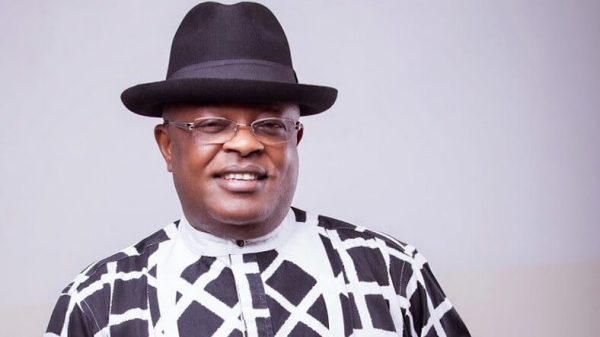






















Chief Dan Osi Orbih built much of his political reputation battling Adams Oshiomhole in Edo State, but one of his most consequential interventions occurred across the state border in Rivers State.
That intervention became part of the political rupture between Nyesom Wike and Rotimi Amaechi, helping to alter the balance of power in Rivers politics and, ultimately, contributing to Wike’s emergence as one of Nigeria’s most enduring political figures.
At the centre of the controversy was a disputed Peoples Democratic Party congress, two rival claimants to the state chairmanship and an affidavit sworn by Orbih that proved damaging to the Amaechi camp.
The disputed 2012 PDP congress
The story began with the Rivers State PDP congress held on March 17, 2012.
At the time, Amaechi was governor and the undisputed leader of the PDP establishment in Rivers. His political ally, Chief Godspower Ake, emerged as chairman at the congress held at the Alfred Diete-Spiff Civic Centre in Port Harcourt.
The PDP panel appointed to conduct the congress was headed by Orbih, who was then Edo State PDP chairman.
Few could have anticipated that Orbih’s account of what happened at the congress would later become crucial in the battle for control of the Rivers PDP.
When Wike and Amaechi became rivals
Wike had once been one of Amaechi’s closest political associates. He served as the governor’s Chief of Staff and had played a significant role in Amaechi’s political battles surrounding the 2007 Rivers governorship election.
His political fortunes changed after President Goodluck Jonathan appointed him Minister of State for Education.
By 2013, however, the relationship between the two men had spectacularly deteriorated.
Amaechi was increasingly at odds with the Jonathan administration, while his position as chairman of the Nigeria Governors’ Forum became another source of political tension.
At home in Rivers, Wike emerged as perhaps his most formidable political challenger.
But Amaechi still controlled the PDP machinery. He had Government House, most of the local government chairmen and an overwhelming majority of PDP lawmakers behind him.
For Wike to mount a serious challenge against his former political ally, control of the party structure was crucial.
That was where the controversy surrounding the 2012 congress became decisive.
Felix Obuah and Dan Orbih enter the dispute
Felix Obuah and Walter Opuene went to court, claiming that they, rather than Ake and his secretary, had been validly elected chairman and secretary at the March 17 congress.
The case came before Justice Ishaq Bello of an Abuja High Court.
Among the evidence central to the dispute was the account of Orbih, the man who had headed the panel that conducted the congress.
Orbih swore an affidavit disputing the result being presented by Ake.
The court accepted Orbih’s deposition that the result Ake was presenting did not emanate from the congress conducted by his panel. His evidence supported the result presented by Obuah.
The development was politically explosive.
The Amaechi camp strongly challenged Orbih’s account, insisting that video evidence showed him conducting the congress at which Ake emerged chairman. The faction also maintained that officials of the Independent National Electoral Commission had observed the process.
The Ake camp subsequently complained that the court had failed to admit video evidence which it said supported its version of events.
Amaechi’s then Commissioner for Information, Ibim Semenitari, publicly expressed the camp’s bewilderment that Orbih, whom they regarded as having conducted the congress that produced Ake, could later take a contrary position.
But Orbih had already placed his account before the court under oath.
The consequences would prove enormous.
The day Amaechi lost the PDP structure
On April 15, 2013, Justice Bello delivered a judgment that dramatically altered the political landscape in Rivers State.
The court removed the Godspower Ake-led executive loyal to Amaechi and recognised the executive headed by Felix Obuah, who was aligned with Wike.
Orbih’s deposition concerning the disputed congress results featured prominently in the case.
The PDP’s national leadership moved swiftly.
On April 16, the party’s National Working Committee inaugurated the 27-member Obuah executive in Abuja, giving it national recognition and effectively transferring the recognised Rivers PDP structure away from the sitting governor’s faction.
It was an extraordinary political reversal.
Amaechi remained governor and continued to enjoy substantial political support. Twenty-five of the 32 PDP legislators in the Rivers House of Assembly rejected the Obuah leadership and declared support for Ake.
The state’s 23 local government chairmen were also reported to have rejected the new executive.
But the political reality had changed.
Amaechi had lost control of the officially recognised structure of his own party.
Wike now had the platform from which to wage a political battle against his former boss.
Wike moves in
The political loyalties of the competing factions were clear. Contemporary reports routinely described Ake’s executive as pro-Amaechi and Obuah’s as pro-Wike.
The confrontation quickly intensified.
The Obuah-led PDP moved against politicians loyal to Amaechi, while the governor’s allies in the House of Assembly targeted the leadership of Obio/Akpor Local Government Area, Wike’s political base.
Five Rivers lawmakers emerged firmly on Wike’s side despite the overwhelming pro-Amaechi majority in the House.
The confrontation eventually fed into the notorious Rivers State House of Assembly crisis that attracted national attention.
Wike openly celebrated the change in the PDP structure. At an event involving the new executive in May 2013, he declared that political power had returned to its “original owners.”
Amaechi’s isolation within the PDP deepened.
On May 27, 2013, the party’s national leadership suspended him — an unprecedented move involving a sitting governor and chairman of the Nigeria Governors’ Forum.
Months later, Amaechi joined other rebel PDP governors in defecting to the newly formed All Progressives Congress.
Wike stayed in the PDP.
Crucially, his allies controlled the party machinery.
The Orbih factor
Orbih’s role in the episode is significant, although it should not be overstated.
He did not single-handedly wrest control of the Rivers PDP from Amaechi. The struggle involved Wike, Obuah, the PDP national leadership, politicians opposed to Amaechi and a fiercely contested judicial process.
The wider conflict also unfolded against the backdrop of Amaechi’s deteriorating relationship with the Jonathan administration, prompting allegations from his supporters that federal political forces were determined to weaken him.
But Orbih cannot be written out of the story.
He chaired the panel that conducted the disputed congress.
When the battle moved to the courtroom, his sworn account of what his own panel had done became consequential evidence.
The court accepted that evidence in reaching a judgment that displaced the Amaechi-backed executive and recognised the faction aligned with Wike.
The political consequences went far beyond deciding who would occupy the Rivers PDP chairman’s office.
Amaechi lost the recognised party structure.
Wike gained the platform from which he could organise politically against the governor.
Amaechi subsequently left the PDP.
Two years later, Wike used the PDP platform to contest the 2015 Rivers governorship election, defeating the man whose political lieutenant he had once been and succeeding him as governor.
For Orbih, who died on August 31, 2026, the Rivers episode remains a fascinating chapter in a political career more commonly associated with Edo State.
He would later become politically close to Wike during the PDP’s national struggles, particularly the internal battles that followed the party’s 2022 presidential primary. But their political paths had intersected dramatically long before then.
In 2013, Amaechi possessed almost everything normally required to control a ruling party in his state: the governorship, lawmakers, local government chairmen and an established political machine.
Yet he lost control of the recognised PDP structure.
Wike emerged from the upheaval with the party platform that would ultimately carry him into Government House.
And in the legal and political manoeuvring that produced that extraordinary reversal was an Edo politician named Dan Osi Orbih, whose evidence concerning a congress he had personally supervised helped tilt one of the defining political battles in modern Rivers State history.