


























Industry leaders have highlighted that Nigeria’s digital economy will require stronger local infrastructure, trusted digital identity and skilled talent to translate the country’s growing technology adoption into greater economic value, reports ravenewsonline.
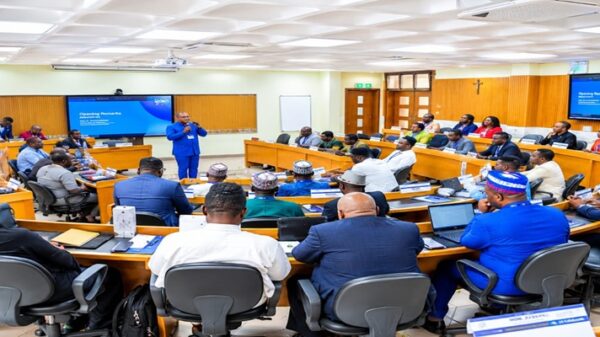
The stakeholders made the remarks in Lagos on September 24, 2026, at the inaugural GrowthX by Techeconomy & TiLAwards.
Adesola Akinsanya, president of the Nigeria Internet Registration Association (NiRA), delivering a goodwill message, said Nigeria’s digital growth could no longer be driven by technology alone, insisting that collaboration among people, institutions and businesses would be critical to turning innovation into economic impact.
“Digital growth is no longer driven by technology alone. It is driven by what happens when technology, people, institutions, businesses decide to move in the same direction, and at the same time, and with the same sense of purpose,” he said.
Akinsanya said the gap between Nigeria’s digital potential and its real-life economic impact could be narrowed through three critical elements: trust, talent and infrastructure that carries a Nigerian identity.
“The gap closes only when three things are in place. Trust that people can rely on, talent that can build on it, and infrastructure that carries a Nigerian name,” Akinsanya said.
According to him, NiRA had focused on developing local digital capacity through initiatives such as the .ng Academy, while also strengthening trust in the country’s internet infrastructure through domain name security.
“We believe digital growth is not only about servers, satellites, or cables. It is about people who understand, manage, and create value from that technology. That is why we built the .ng Academy.”
He outlined NiRA’s implementation of Domain Name System Security Extensions (DNSSEC), describing it as a technological safeguard designed to protect .ng domains from being hijacked.
Dr. Ayotunde Coker, chief executive officer, Open Access Data Centre (OADC), in his opening remarks, placed Nigeria’s digital transformation within the broader context of the economy, arguing that information technology now underpins virtually every major sector.
According to Coker, the contribution of technology to Nigeria’s GDP had grown significantly over the years, but he argued that its wider economic impact went beyond what official GDP measurements capture.
He cited banking, oil and gas, government services and other sectors as examples of areas whose operations increasingly depend on digital infrastructure.
“You can’t move money without information technology. Even oil and gas needs information technology for its exploration. You can’t operate banking without information technology,” he said.
Coker stressed that the reliability of digital infrastructure was particularly important for financial institutions, noting that failures in power, data centres or connectivity could have consequences that extend beyond technology operations.
“If you don’t have power, your data centre can’t operate. If your data centre doesn’t operate, your connectivity systems are down. Your banking platforms are down. The entire bank just goes quiet,” he said.
He explained that the country’s digital infrastructure ecosystem had also evolved considerably, with improvements in connectivity, data centres and subsea cable capacity creating a stronger foundation for emerging technologies such as artificial intelligence.
Meanwhile, he added that the growth of cloud computing, smartphones, connectivity, big data, blockchain and AI was creating a new phase of technological development in Nigeria.
He also highlighted Nigeria’s position in the subsea cable ecosystem, pointing to the expansion in international connectivity capacity following the arrival of major cables.
He said the development of hyperscale data centres and AI-ready infrastructure would further shape Nigeria’s ability to participate in the next phase of the digital economy.
The remarks point to a growing emphasis on the infrastructure beneath Nigeria’s digital transformation, from domain security and local digital identity to data centres, connectivity, cloud infrastructure and the skills required to operate them.
Akinsanya added that infrastructure alone would not be sufficient without collaboration and trust.
“Nigeria’s digital growth will be strongest not when we have more technology, but when innovation is matched with collaboration. Trust, local digital identity, and skilled people, all working within an ecosystem that lets businesses participate and grow,” he said.
He urged stakeholders to prioritise collaboration as Nigeria seeks to build a digital economy in which businesses can scale and more citizens can participate.
Digital payment fraud losses in Nigeria fell 51 per cent to ₦25.85 billion in 2025, from ₦52.26 billion in 2024, even as social engineering, not technical intrusion, remained the leading fraud technique, with insider involvement posing the gravest risk, cybersecurity strategist and futurist David Adeoye Abodunrin, told delegates at the conference.
Delivering the keynote address, “Trust by Design: Building Nigeria’s Next Generation of Digital Payments and Infrastructure,” at The Civic Centre, Victoria Island, Abodunrin, founder of Cubed Integrated Consulting and Cyberfore Consulting, and author of Fintech Black Box, argued that Nigeria’s payments challenge is architectural rather than technical.
“Nigeria does not have a payment problem. It has a trust-architecture problem,” he said, framing trust as infrastructure rather than a compliance function.
The fraud figures, which Abodunrin attributed to the Nigeria Inter-Bank Settlement System (NIBSS), come as the country’s instant payment rails have scaled sharply: digital payments crossed ₦1 quadrillion in a single year, with more than 11.2 billion instant transfers processed on NIBSS’s NIP platform, according to NIBSS figures cited in the presentation.
Abodunrin’s remarks echoed Central Bank of Nigeria Governor Olayemi Cardoso, who said in unveiling the apex bank’s Payments System Vision 2028 that “a payment system is only as strong as the trust people place in it.” The PSV 2028 target is to bring fraud losses below 0.001 per cent of transactions.
To close that gap, Abodunrin proposed a five-layer “Trust-by-Design Stack”: secure code built on zero-trust and maker-checker controls; resilient rails designed to assume breach and be tested for recovery rather than merely documented; behavioural design that accounts for “the least digital Nigerian,” including multilingual fraud alerts and confirm-the-payee prompts; sovereign data practices built on data minimisation and consent, citing the National Identity Management Commission’s rollout of consent-based NIN verification this week as an example; and shared accountability across banks, fintechs and telecom operators.
On the shared-accountability layer, Abodunrin pointed to the United Kingdom’s mandatory reimbursement regime for authorised push-payment fraud victims, in force since October 2024, with claims of up to £85,000 split between sending and receiving institutions, India’s UPI model of shared public payment rails, and the Pan-African Payment and Settlement System (PAPSS) as reference points for cross-institutional cooperation.
Abodunrin, who believes CBN’s data localisation is a right call, closed by launching what he called the “Lagos Trust Pact,” a five-point voluntary commitment inviting banks, fintechs, regulators and founders to design trust into systems from the outset, share threat intelligence in real time, test, rather than just document, recovery plans, design for less digitally literate users, and report trust metrics with the same rigour as revenue.
He set a 90-day challenge for organisations to run a self-assessment scorecard, log security shortcuts against named owners and deadlines, and reconvene to compare progress at GrowthX 2027.
Meanwhile, stakeholders in the financial sector have raised the concern over the January deadline given by the Central Bank of Nigeria (CBN) on data localisation.
Worried about the timing, they said that it was rather too short and warned that the CBN’s six-month deadline for full data localisation by January 2027 is virtually impossible to achieve. They therefore called for extension of time to meet up with the directive.
Blessing Ehize, Chief Technology Officer, FCMB, opined that a major point of friction is the perceived lack of direct regulatory engagement trailing the policy announcement.
Ehize disclosed that despite attempts through groups like the Committee of Bank CIOs, clarity remains elusive regarding what specific data must sit on-premise versus what can reside in hybrid cloud environments.
“Now, this is the problem. To bring payment data back on-premise, for the last three months, we’ve not been able to engage effectively with the Central Bank of Nigeria as the Committee of Bank CIOs to get clarity on these issues. I mean, you can ask, I’m representing banks. From what I know, there’s not been a meeting held to say, ‘This is what it means’ in terms of clarity. So it’s vague. You start thinking, ‘Are we really trying to play with the financial sector?’ This is where we need to start from: draw a roadmap. By this milestone, we should have done this. We really have the capacity to do this as a country, but we just need to plan it and not rush the Nigerian way,” he stated.
Hakeem Adeniji-Adele, Deputy Managing Director, eTranzact, however, said the CBN had been engaging the Fintech community.
But he frowned at the six months deadline, stressing that the timing is rather too short, looking at the enormous data sitting in the cloud somewhere.
“I believe, is quite short, simply because of the amount of load that needs to be moved. I feel the solution should be a phased approach. Compute and storage should be divided into two, as opposed to telling everyone to move at once,” he said.
Earlier in his address, Peter Oluka, the founder/editor in-chief of Techeconomy, said that GrowthX is a platform created to bring together the people and institutions shaping Africa’s digital economy for substantive conversations about innovation, infrastructure, regulation, investment and inclusive growth.
“It is not designed simply to celebrate technology. It is designed to ask the harder questions: What will it take to scale innovation? How do we build digital infrastructure that can support the next generation of businesses? How can regulation protect consumers while enabling innovation? How do we build and deploy AI for Africa’s realities? How can data, digital identity and secure payments strengthen trust in the digital economy?
“And ultimately: How do we turn technological progress into sustainable economic growth?
“GrowthX recognises that the most consequential challenges facing Africa’s digital economy cannot be solved by one sector alone,” he said.