























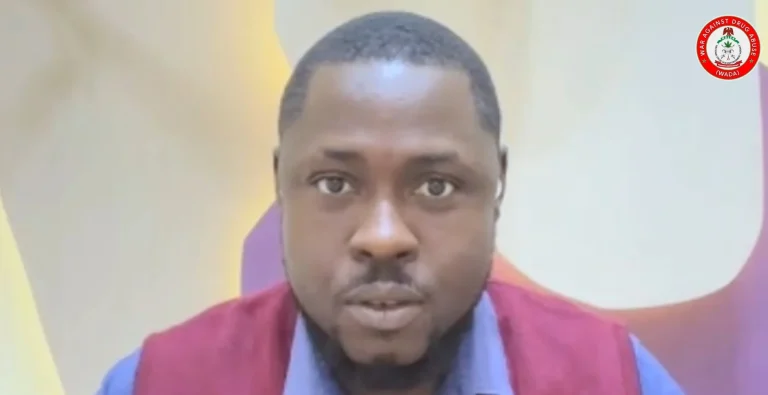
A recovering drug addict, Abraham, has opened up about how substance dependence cost him his job, damaged his family relationships and robbed him of nearly 10 years of his life.
Abraham shared his experience on NarcoTales S4 E8, aired on NDLEA TV’s YouTube channel on Friday, recounting his difficult journey from addiction to recovery.
He said he realised how serious his addiction had become after losing his job at an oil company because of his offensive body odour.
According to him, his colleagues would open the office windows and air conditioner and spray air freshener whenever he arrived at work.
“When I got employed, I got a job opportunity in an oil company. I’ve always said this is a company I was promised. The job was more in my favour than I was given the job I was applying for.
“People kept complaining that my body was bringing up very offensive smell. Most of the time, when I came to the office, they would open the AC, open the windows, they would be spraying air freshener up and down.
“I couldn’t last on the job beyond a couple of months. They had to let me go and put me on sick leave.”
Abraham said losing his job forced him to confront his drug dependence.
He explained that the pain that initially drove him to drugs was no longer present, but he continued using them because of uncontrollable cravings.
“At that point, I knew that. That was also the point when I realised that the initial pain that made me start taking it, I was no longer feeling it. But yet, I was taking the drug based on impulse. Whenever the craving comes, I just rush in. It was like automated.”
Addiction strained family relationships
Abraham said his addiction affected virtually every area of his life, including his finances, health, career and relationships.
He said the situation also took a toll on his parents and siblings, revealing that his mother and father eventually separated while his mother was trying to help him.
“In the course of my addiction challenge and my mom trying to help me, my mom and my dad separated. You can see that it’s not just me that’s affected. It affected my family at large.”
He added that his relationship with his siblings remained strained even after his recovery.
“My siblings right now, even though I’ve recovered, because of that strain over the years of the addiction, we now feel like strangers. That connection is no longer there.”
‘I lost almost 10 years of my life’
For Abraham, however, the greatest cost of his addiction was the time he lost.
He said he became addicted in his mid-20s and did not fully understand what it meant to live without the euphoria associated with drug use until he reached his 30s.
“I lost almost 10 years of my life due to this. So why am I missing this beautiful life for themselves? Getting a job, getting married, just a beautiful life for themselves. I miss those opportunities.”
He said although money could be lost and recovered, time could never be regained.
“I could have saved money, but you can lose money and regain money. But time is something you can’t regain. You can’t regain time.”
Addiction left lasting physical scars
Abraham also spoke about the physical consequences of years of drug use, including scars from needle injections, difficulty walking and the loss of activities he once enjoyed.
“I think it’s the scars on my body. The scars. Up till now, you know when you just feel, you wake up and you see your body and you’re like, it’s a dream.”
He said he could no longer run, dance or engage in some of the activities he once loved.
“The consequence of knowing that I won’t be able to run again. I used to love dancing and that’s gone. Knowing that I’m partially disabled, anytime I need to walk, I need to limp alongside.”
He said he often wore long sleeves and socks to conceal his scars because he felt uncomfortable exposing them in public.
Abraham also recounted some of the extreme actions he took during his addiction, including stealing from his mother and begging strangers for money to fund his drug use.
“I never knew I was capable of stealing. So I stole from my mum when the addiction was, when the crazy was serious.”
He said he also attempted suicide on three occasions and became dependent on strangers for money.
Recovery and support
Abraham said his recovery was made possible by people who continued to believe in him, including his pastor, church members and professionals who supported him.
His first rehabilitation attempt lasted about a month, but he relapsed several weeks after leaving the facility.
He said his subsequent rehabilitation experience was different because he had a strong support system that continued to monitor, encourage and assist him.
According to him, his pastor helped him secure rehabilitation and remained actively involved throughout his recovery.
“I did not feel alone. Members of the church, even the ones that were doctors, sometimes they would come with food, they would come visit and there were a couple of church members that worked in the hospital there. So most of the time they were always checking up on me.”
Abraham said returning home after rehabilitation presented another challenge when he discovered that he had lost his accommodation and had nowhere to stay.
He relied on his pastor, psychologist and other members of his support network as he adjusted to life after rehabilitation.
He also learned wig-making and other hair-related skills to keep himself occupied while rebuilding his life.
“I had something to fight for. I had something to live for. I had a purpose to chase after him. So, my mind was no longer idle anymore.”
He said his advocacy work, through which he speaks to students and others about drug abuse and recovery, has also helped him remain focused.
Abraham urged people struggling with addiction to acknowledge the problem, speak out and seek professional help.
“I would tell the person, see, there’s never a time that is too late to stop. There’s never a time too late to stop. Stop now, while you still can.
“Addiction flourishes in silence. Speak out. Seek help.”