





























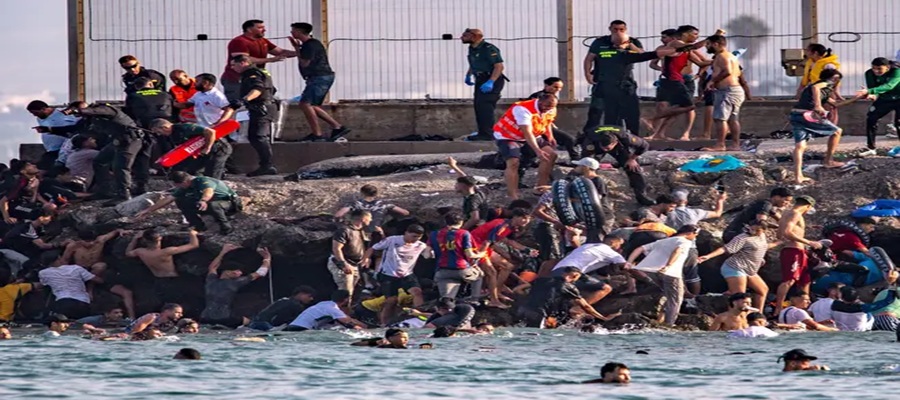
Spanish authorities say more than 49,000 migrants entered the country’s North African enclave of Ceuta from neighbouring Morocco within a single day, in what is being described as one of the largest mass border crossings in Spain’s history.
According to Spanish authorities, the majority of the migrants crossed into the enclave on Thursday by swimming around a breakwater separating Morocco from Ceuta, overwhelming border security personnel and prompting the deployment of the Spanish military to reinforce the area.
The authorities said the unprecedented influx far exceeded the peak daily arrivals recorded during Europe’s 2015 migration crisis, when hundreds of thousands of refugees entered the continent through Turkey.
Spain’s National Security Department, under the Prime Minister’s Office, said in an online statement that more than 49,000 people entered Ceuta during the mass crossing.
The statement, which was later removed, also disclosed that security officials recovered the bodies of 19 migrants from the sea during rescue and recovery operations.
Officials said the migrants were predominantly young Moroccan men, although the group also included women, children and nationals of other countries.
Spanish media reported that additional groups attempted to scale border fences into Ceuta on Friday, leading to clashes with security personnel.
However, thousands of migrants were also reported to have voluntarily returned to Morocco after learning they would not be permitted to remain in Spanish territory.
The Spanish government said Madrid and Rabat had agreed to strengthen bilateral cooperation to facilitate the swift return of migrants who entered Ceuta irregularly.
In a statement, the government said both countries would review existing measures to improve coordination on border management and migrant repatriation.
Spanish authorities attributed the surge largely to the activities of people-smuggling networks, accusing them of exploiting vulnerable migrants.
The government also linked the development to a recent ruling by Spain’s Supreme Court, which prevents authorities from intercepting and immediately returning migrants who reach the enclaves of Ceuta and Melilla by sea.
Ceuta and Melilla, Spain’s two autonomous enclaves on the northern coast of Africa, have long served as key entry points for migrants seeking to reach Europe.
The latest incident is expected to intensify discussions within Spain and the European Union on migration management, border security and cooperation with North African countries to curb irregular migration.