






























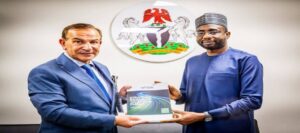
National Information Technology Development Agency (NITDA) and Wigwe University are laying the groundwork for a far-reaching collaboration centred on artificial intelligence (AI) research, agricultural innovation and digital talent development, following a high-level engagement between both institutions in Abuja.
NITDA
The discussions, led by Wigwe University Vice Chancellor Professor Marwan Al Akaidi and senior NITDA officials, revealed an alignment of expertise, priorities and national objectives that could accelerate Nigeria’s technological advancement.
Professor Al Akaidi, who leads the young but ambitious Wigwe University established under the vision of the late Herbert Wigwe, said the institution was created to become “the university of Africa”, providing high quality teaching and transformative research for Nigeria and the continent.
He emphasised that Nigeria has immense talent but often lacks the opportunities and platforms to channel it effectively—an issue the university intends to solve through strong industry and government partnerships.
Drawing from his long academic and research career in the United Kingdom and the Middle East, Professor Al Akaidi shared that the university is already conducting work on AI for Health in Nigeria with a team of ten researchers.
He stressed his determination to build a full AI centre in the country, similar to the one he helped establish in Abu Dhabi, noting that although funding setbacks followed Herbert Wigwe’s passing, the ambition remains intact and urgent.
According to him, Wigwe University does not seek to become a passive user of foreign AI tools but aims to “create the Nigerian AI”—a locally driven, world class AI engine that reflects the country’s needs, languages and realities.
He further explained that the university’s location in Rivers State provides a natural foundation for AI enabled agriculture and food production research.
Surrounded by extensive farming communities, the institution sees opportunities to apply AI to livestock management, land use, food processing and agricultural efficiency.
Using Nigeria’s cattle population as an example, he argued that technology can dramatically improve productivity: “In countries with fewer cattle, output is far higher because of new feeding systems and technology. If we apply AI properly, Nigeria’s agricultural wealth can multiply.”
He also pointed to AI’s potential in hospitals and medical diagnosis, especially for widespread illnesses like malaria.
NITDA’s representative, Dr Aristotle, welcomed the visit warmly, calling the Agency “Nigeria’s technology powerhouse” with mandates covering IT development, regulation, innovation, research and standards.
He said the Vice Chancellor’s proposals align strongly with NITDA’s strategic direction and existing programmes, highlighting the National Centre for Artificial Intelligence and Robotics and the National Adaptive Village for Smart Agriculture as key areas where collaboration can take shape.
He praised Wigwe University’s focus on entrepreneurship, innovation and skills development, noting that academia is a crucial stakeholder in the national tech ecosystem.
He also explained that NITDA’s work aligns closely with the government’s priority agenda and the Agency’s Strategic Roadmap and Action Plan, built on pillars such as knowledge, research and development, entrepreneurship, innovation and partnership.
He assured the visiting delegation that NITDA sees collaboration as essential and is committed to implementation rather than discussions alone: “Whatever we commit to, we will do. We understand the importance of partnership because no single institution has all the answers.”
Building on this, NITDA’s Director of Research and Development, Dr Kumo, said the Agency is working to develop a technology research ecosystem capable of moving Nigeria into the top 25 per cent of global research performance.
He noted that many of Wigwe University’s interests—AI, robotics, unmanned aerial vehicles, the Internet of Things, blockchain and additive manufacturing—mirror NITDA’s research priorities.
He also emphasised the value of virtualising education, allowing learners anywhere in Nigeria to access Wigwe University’s programmes through technology, improving national inclusivity.
From the Digital Literacy and Capacity Building Department, Dr Tambuwal stressed that NITDA prioritises building a digitally literate population and developing talent from basic education through to tertiary level.
He noted that many workers today still lack the digital skills required to use modern systems effectively, making it essential for universities to produce graduates who are digitally fluent and ready for the workforce.
He expressed readiness to partner with Wigwe University and explore shared learning opportunities.
Returning to curriculum and industry alignment, Professor Al Akaidi stressed that academia needs industry just as much as industry needs academia.
He described the need for constant curriculum review, especially in computing, engineering and technology, to ensure students are not learning outdated content.
He explained that teaching must be underpinned by active research and that the real value of education lies in producing graduates who understand the technology and can lead in their fields.
At Wigwe University, he said, students are already demonstrating remarkable capability—second year students are set to launch a major educational app, showing what young people can achieve when supported and challenged.
He insisted that Nigerian universities must produce graduates who are not only job seekers but job creators, noting that Wigwe University is building such a culture deliberately.
His call to action was clear: “We need to work together. If we combine our strengths, we can produce something real for Nigeria and beyond.”
The meeting ended with mutual assurance that the collaboration will move into concrete action. Both sides agreed to identify dedicated contact teams and map out specific workstreams for AI research, agricultural innovation, virtual learning, digital literacy, curriculum development and emerging technologies. With this shared resolve, NITDA and Wigwe University appear ready to build a partnership capable of shaping Nigeria’s technological future.