






























The Nigerian Communications Commission (NCC), stakeholders in the academia, the public sector and enthusiasts of technology for development, have deliberated on the benefits derivable from emerging technologies such as Blockchain, to advance the growth of the Nigerian economy.
The commission through Dr. Ikechukwu Adinde, Director, Public Affairs, disclosed this at a recently-organised two-day workshop, in collaboration with the Bureau of Public Sector Reforms (BPSR).
He noted that stakeholders were in accord that through effective implementation of policies as expressed in guidelines, regulations and directions driven by the NCC, Blockchain could be a bedrock of economic innovation and growth.
The workshop, which took place in Abuja and focused on ”Distributed Ledger Technology (Blockchain) Ecosystem, Decentralisation and Adoption Methods”, drew participants from financial institutions, Ministries, Departments and Agencies (MDAs), the academia, the Nigerian military, and paramilitary forces, the Nigerian Cyberwarfare Command, and the private sector.
The stakeholders, who spoke in turn at the workshop, acknowledged and profoundly appreciated the role of NCC in engendering a dynamic digital regulatory environment, the remarkable contribution to the growth and development of novel and emerging technologies, and NCC’s adoption of adaptive mechanisms that have enhanced emerging technologies in Nigeria.
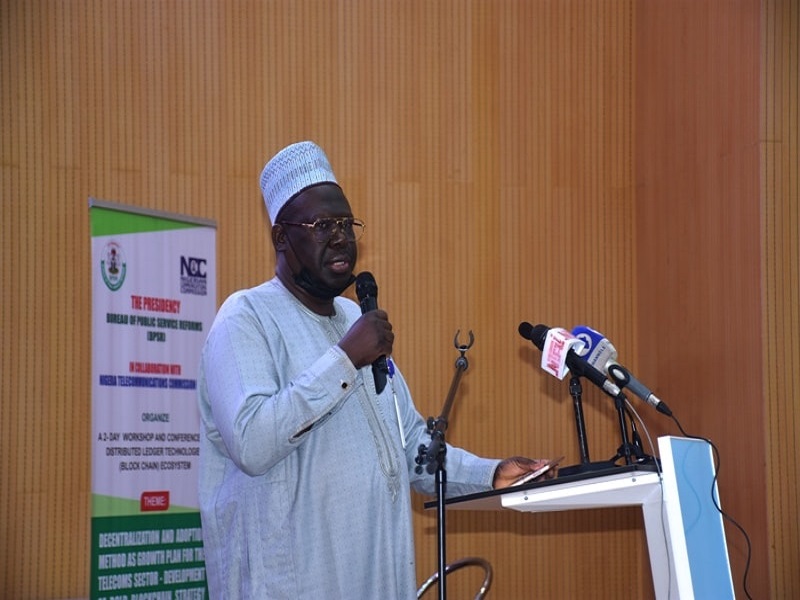
Addressing a large audience at the event, NCC’s Director, New Media and Information Security, Dr. Haru Al-Hassan, who delivered the opening speech at the event, on behalf of the Executive Vice Chairman of the Commission, Prof. Umar Danbatta, said existing national digital economy frameworks such as the National Digital Economy Policy and Strategy (NDEPS), 2020-2030 instituted by the Federal Government as well as regulatory initiatives by the Commission, have been significant enablers of Blockchain and emerging technologies in the country.
According to Al- Hassan, “good regulatory policies are the bedrock of innovation and growth and it is the aspiration of the Commission that Distributed Ledger Technologies (DLTs) otherwise known as Blockchain and other innovative technologies and services would continue to thrive and contribute to the growth and development of Nigeria.”
In the same vein, the Director-General, BPSR, Dr. Dasuki Arabi, informed the audience that the Nigerian government was already making efforts, through a number of initiatives, to harmonizing emerging technologies with the contemporary public service sector in a way that strengthens the efficiency of the public sector. He also affirmed that Blockchain would be central in the implementation of the National e-Govt Masterplan.
The BPSR Chief Executive equally listed the introduction of the Treasury Single Account (TSA), the Integrated Payroll and Personnel Information System (IPPIS), the Bank Verification Number (BVN), automation of enforcement activities of some agencies of the government, including the Federal Road Safety Corps (FRSC), as well as automated performance measurement systems for public sector employees, as concrete examples of the utilisation of technology in the public sector.
Arabi asserted that Nigeria ranks third in Africa, in the use of telecommunications for public service delivery, coming behind South Africa and Egypt. Arabi called on policymakers to ensure robust policy formulation that ensures improved digital literacy and increased automation in public service delivery.
Other speakers at the event included Dr. Abdul-kareem Oloyede of University of Ilorin, Kwara State; Amaka Ukwueze and Vivian Okonkwo, both of the University of Nigeria, Nsukka (UNN), Enugu State, and Col. Romi Legha of the Indian High Commission.
Oloyede, who clarified the difference between Blockchain and Bitcoin, stated that the former is the underlying technology used for Bitcoin and other cryptocurrencies. He also stated that Blockchain could be utilised to minimise expenditure and expenses, speed up transactions, and improve data security for financial institutions, health care, and businesses.
Ukwueze particularly applauded the Commission for taking the lead in discussions on DLTs considering the fact that Nigeria does not have a clear-cut Blockchain policy yet, even though countries worldwide had begun integrating DLT as a central part of their business practices.
“Republic of Malta, a southern European island country, located in the south central region of the Mediterranean Sea, incorporated Blockchain into its digital and economic ecosystem. Also, China, Abu Dhabi, and Japan are also instituting DLT-friendly regulations in their governance processes,” Ukwueze said.
Accordingly, Ukwueze urged the Federal Government to adopt Blockchain deployment actively, promote legal certainty for Blockchain applications, and provide a flexible and adaptive regulatory environment that fosters innovation. Conclusively, Ukwueze stated that “government’s regulatory enforcement processes must seek to encourage companies to be consumer-centric and ensure compliance”.
In her contribution to the discourse, Okonkwo said adoption of Blockchain technology would be essential in documentation, archiving, cloud storage, identity management, and online education. Additionally, Okonkwo declared that blockchain is a cost-effective method of optimising the quality of the educational administrative processes, and equally a cost-effective application that could improve service delivery across the nation.
The DLT, such as Blockchain, DAG; Hashgraph; Holochain; Tempo (Radix), is a digital system for recording transactions of assets at multiple places simultaneously. The key features of DLT include: immutability (once written, it is extremely difficult to alter), and peer-to-peer sharing, in the sense that ledger is shared among peers while there is no central ownership.
Dr Haru Al-Hassan, Director, New Media and Information Security, Nigerian Communications Commission (NCC), represented the Executive Vice Chairman, NCC, Prof.Umar Danbatta at the event.