
























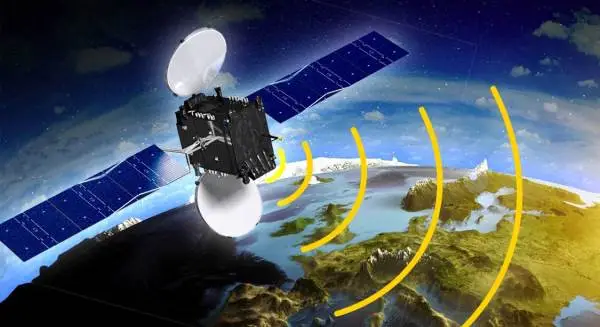
Nigeria has selected Thales Alenia Space of France and Israel Aerospace Industries (IAI) to build two new communications satellites aimed at expanding broadband capacity and replacing the ageing NIGCOMSAT-1R.
The development follows the approval of the project by the Federal Executive Council (FEC), paving the way for Nigeria Communications Satellite Limited (NIGCOMSAT) to acquire and deploy NIGCOMSAT-2A and NIGCOMSAT-2B.
The two satellites are expected to provide additional capacity for broadband, broadcasting, enterprise connectivity and government services, particularly in communities where fibre and other terrestrial networks are difficult or expensive to deploy.
NIGCOMSAT-1R, Nigeria’s current communications satellite, was launched on Dec. 19, 2011, with a 15-year design life.
The satellite is expected to reach the end of its design life in 2026, although NIGCOMSAT said careful management of its onboard fuel could keep it operational until 2028.
The extension gives the Federal Government a limited window to complete the financing, construction and deployment of its replacement.
The Managing Director and Chief Executive Officer of NIGCOMSAT, Mrs Jane Nkechi Egerton-Idehen, said the final cost of the project would be disclosed after the financing arrangements had been concluded.
“The amount will be official once the financing is closed. That’s the stage that is ongoing now after the contract FEC approved,” Egerton-Idehen said.
She said the project would be vendor-financed and backed by export-import banks.
The financing arrangement means the selected vendors will provide financing supported by export-import banks.
The satellite replacement project follows a competitive procurement process that began more than two years ago.
NIGCOMSAT began defining the technical requirements for the project in early 2024 and issued an Expression of Interest in June of that year.
The procurement process advanced in 2025, with international aerospace companies, including Thales Alenia Space, Airbus, IAI, China Great Wall Industry Corporation and Turkish Aerospace Industries, participating.
The final selection assigned Thales Alenia Space and IAI responsibility for delivering the two satellites and associated infrastructure.
The contract covers more than the manufacture of the satellites.
It also includes launch and in-orbit testing, satellite control centres, tracking and telemetry stations, simulators, operational software, documentation, insurance, training and technology transfer.
NIGCOMSAT-2A is planned for deployment at 42.5 degrees East, while the project also includes backup ground infrastructure to improve the resilience of the satellite system.
The new satellites are expected to increase capacity for broadband, broadcasting, enterprise connectivity and government applications.
They could also help extend communications services to communities that terrestrial networks struggle to reach.
Nigeria’s broadband penetration stood at 56.7 per cent as of June, increasing the need to expand access to underserved and difficult-to-reach areas.
While fibre remains the preferred option for high-capacity broadband, particularly in urban areas, deploying terrestrial infrastructure across sparsely populated or difficult terrain can be costly.
Satellite technology can provide coverage across large geographical areas without requiring extensive physical infrastructure on the ground.
The new satellites are therefore expected to complement, rather than replace, Nigeria’s fibre and mobile networks.
Their capacity could be used by internet service providers, mobile network operators, broadcasters, businesses and government agencies to extend services to underserved locations.
However, industry analysts note that additional satellite capacity will not automatically translate to cheaper or better internet services for consumers.
The affordability of satellite terminals, equipment, data services and last-mile connectivity will determine how widely the services can be accessed.
The project is also expected to support Nigeria’s space and digital technology ecosystem through opportunities in satellite terminals, ground infrastructure, systems integration, technical support, telecommunications and broadcasting.
The contract also includes provisions for knowledge transfer and training to help develop local expertise in satellite engineering, space operations and ground-segment management.
Egerton-Idehen said the objective was to translate the satellite investment into measurable benefits for Nigerians.
“NIGCOMSAT-2A and NIGCOMSAT-2B will strengthen our national satellite capacity, expand connectivity and support critical communications across the country,” she said.
“Our priority is to translate this investment into measurable value for Nigerians and position NIGCOMSAT for stronger impact within the global satellite and digital economy.”
She said the additional satellite capacity would need to attract sustained demand from telecommunications operators, internet service providers, broadcasters, businesses and government agencies for the investment to achieve its commercial objectives.
The satellites are also expected to strengthen Nigeria’s communications resilience by providing alternative connectivity when terrestrial networks are damaged or unavailable.
This could support critical government operations, emergency communications and other strategic services.
Although the FEC approval and selection of the two contractors mark major milestones, the project still requires the conclusion of financing arrangements, followed by manufacturing, technical preparations, launch and in-orbit testing.
With NIGCOMSAT-1R expected to remain operational until 2028, NIGCOMSAT has a limited period to deliver the replacement satellites before the existing spacecraft reaches the end of its extended operating life.
The project is expected to play a key role in Nigeria’s efforts to close connectivity gaps, especially in rural communities and other locations where fibre and mobile infrastructure cannot be economically deployed.