






























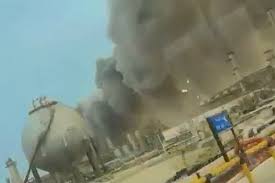
Saudi Aramco has suspended operations at its massive Ras Tanura refinery on the Persian Gulf following a drone strike, as Iranian retaliation intensifies against US and Israeli attacks, sending global oil prices surging over 9 per cent.
Sources familiar with the matter revealed the 550,000 barrels-per-day facility—one of the world’s largest—was halted Monday as a precaution during damage assessments, with a resulting blaze quickly contained and no injuries reported; Aramco and Saudi officials offered no immediate comment.
The strike marks a perilous expansion of hostilities sparked over the weekend by US-Israeli operations killing Iran’s Supreme Leader Ali Khamenei, prompting Tehran to unleash missiles and drones on regional US bases, Israeli targets, and now key energy infrastructure.
Brent crude leaped 9.7 per cent in London trading, with analysts eyeing $100-plus per barrel if disruptions persist, as maritime traffic through the Strait of Hormuz—handling 20 per cent of global oil—has plummeted 70 per cent due to IRGC threats and sky-high war-risk insurance.
Saudi air defences intercepted two drones at Ras Tanura, with debris sparking the fire, amid broader attacks including missiles over Riyadh’s airport and Prince Sultan Airbase; Qatar has similarly paused LNG output.
The shutdown exacerbates supply fears, with Iran halting its own 1.6 million barrels-per-day exports—mostly to China—and Gulf producers risking storage overflows if the crisis drags beyond weeks.
President Donald Trump warned of prolonged strikes on Iran, while markets brace for gasoline spikes and pivots to Russian supply by India and China.
Energy experts decry assaults on infrastructure as a “nightmare scenario,” potentially reshaping global trade as vessels linger in ports or reroute.
Saudi Arabia, the world’s top oil exporter, vows resilience, but the refinery’s key export role amplifies volatility in an already tense Gulf theatre.