


























By Blaise Udunze
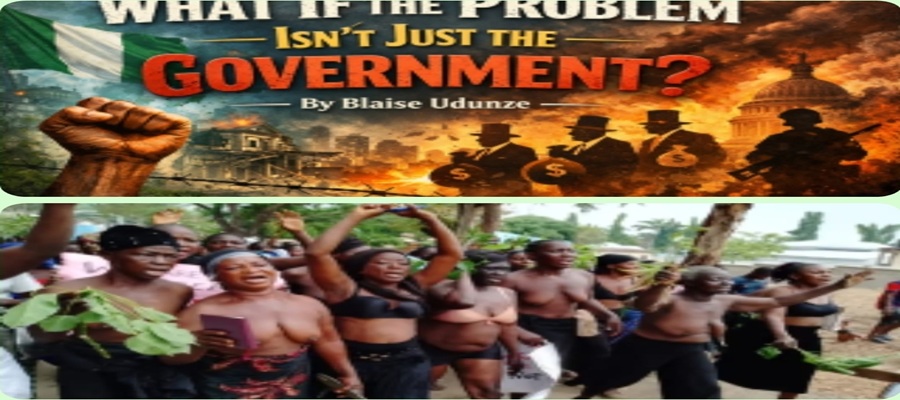
Recent reports in the media space highlighting threats of “naked protests” by market women across several states if the federal government fails to address the issue of hardship underscore the depth of hunger and poverty gripping the nation. No doubt, there is hardship in the country, of which Nigeria’s poverty crisis is often framed as the government’s failure, poor policies, weak institutions, corruption, and economic mismanagement.
From a balanced viewpoint, while these factors are undeniable, they do not tell the full story in its totality. The reality is that the majority of Nigerians, being the larger populace experiencing this challenge, will definitely oppose the ideology that poverty in Nigeria is not merely a policy problem; it is also a societal one. The underlying truth is that this is shaped by citizens’ behaviours, choices, cultural norms, and civic attitudes. This will remain a lived experience of the people until this dimension is confronted honestly; reforms will continue to yield limited results.
Nigeria’s economy has witnessed growth as inflation has decelerated, with headline inflation easing to 15.15percent and food inflation retreating to 10.84 percent, the exchange rate was stabilizing, and foreign reserves ($46.7 billion) had climbed to a seven-year peak, and despite the growth figures and ambitious government targets, millions of Nigerians remain trapped in poverty. More alarming is the recent estimates suggesting that an additional two million people could fall below the poverty line this year alone.
The intrigue is that the geographic distribution of these figures tells a deeper story, and this is more revealing than the numbers; however, there is an uneven geographical spread. Of concern here, which is troubling, is why states such as Yobe, Jigawa, Katsina, Kano, and Zamfara tend to experience or be deep in poverty when compared to other states like Lagos, Port Harcourt, Aba, Enugu, and Onitsha, which are projected to experience less poverty. This disparity raises a critical question, which calls for an urgent answer to why poverty outcomes differ so starkly within the same country, because no doubt, much of the explanation lies beyond government failures.
While governance challenges exist nationwide, the explanation extends beyond Abuja. Perhaps this is from deliberate ignorance of the people; the reality is that it lies in education, cultural practices, social norms, and individual responsibility play decisive roles in shaping economic outcomes.
One key alarming fact that has deeply entrenched poverty in many northern states, unlike other regions, is limited access to education, especially for girls, early marriage, polygamy, and large family sizes. There have been several factors that reinforce cycles of poverty by stretching limited household resources, reducing educational attainment, and limiting economic mobility, and this will continue to be a long-standing challenge or lived experience for the people if not addressed.
It is clearer that practical comparison illustrates this reality. Taking into consideration that a low-income worker in Yobe who marries four wives and raises over twenty children will inevitably struggle to provide adequate education, healthcare, and opportunities for his family, while in contrast, a similar worker in Aba is more likely to marry later, have fewer children, and invest in their education. Without much ado, over time, the children in the latter household acquire skills, productivity, and economic relevance because their parents chose to prioritise education for them, while the former remain trapped in subsistence and dependency. These differences are not subjective; they are structural and measurable.
Religion and culture further complicate the picture as record has it that Nigeria is one of the most religious countries in the world, yet religiosity often serves personal aspirations, prosperity, miracles, or divine favour rather than reinforcing civic responsibility and social ethics. Today in Nigeria, political leaders frequently reinforce this distortion and moral narrative. Only recently, it was announced that public officials in Abuja celebrate marrying off multiple children at once, some governors borrow billions to spend public funds on religious pilgrimages, while underfunding education, healthcare, and infrastructure, they send a clear message about priorities. In contrast, states that invest deliberately in education, such as Enugu with its smart school initiatives, demonstrate how leadership choices influence societal outcomes.
Still, the crisis of responsibility is not confined to any region. It is national, as proved during the discussions at Lagos State’s 12th Summit of the Association of Retired Heads of Service and Permanent Secretaries (ALARHOSPS), it was emphasized that societal progress depends not only on leadership but on citizenship behaviour. According to Professor Wusu Onipede, citizenship is defined by commitment to collective welfare, not mere residence.
The truth is not far-fetched, going by the saying that actions, positive or negative, directly impact society. What would have informed the common actions, such as stealing public assets, vandalizing infrastructure, ignoring traffic laws, or tolerating corruption, all accumulate into widespread societal harm as seen in our everyday lives. Conversely, volunteering, mentorship, and community engagement generate resilience, opportunity, and shared prosperity. With close reading, one will notice that this dynamic was captured succinctly in Professor Oluwatomi Alade’s “Triangle for Change,” which pointed to the home, the school, and the community. Parents must brace up to understand that the primary responsibility is upon them to start prioritising education, teachers who impart both knowledge and character, and communities that uphold civic values create the foundation for sustainable development because the truth is that the change does not only rest on the government. In the same manner, it will be said that neglect in any of these spheres, whether through early marriage, disregard for schooling, or normalization of polygamy, undermines national progress.
Religious institutions, as Professor Oguntola-Laguda argues, must also evolve, which means that beyond spiritual teachings, they should emphasize practical social ethics in the areas of responsibility, productivity, gender inclusion, and civic duty. In regions where harmful norms persist, faith leaders, traditional authorities, and elders possess the influence necessary to drive change, if they choose not to use it, otherwise the society will remain impoverished.
Globally, the link between social norms and poverty is well established, and norms that condone child marriage, gender exclusion, or unchecked family sizes perpetuate intergenerational deprivation. Over the period, in other countries, it is clear that economic interventions alone cannot dismantle these patterns because countries like India show that combining education incentives, political inclusion, and social protection can reduce poverty among marginalized groups. Initiatives such as Uganda’s SASA, which is a program that demonstrates that shifting attitudes toward gender and empowerment lead to improved economic outcomes. Nigeria’s poverty strategy must similarly integrate social transformation with economic reform.
None of this absolves government responsibility. Poorly sequenced reforms, rising taxes, insecurity, weak infrastructure, and inadequate social protection continue to deepen hardship. Senator David Mark of the African Democratic Congress has criticized what he terms “vicious policies” that worsen citizens’ vulnerability. Nigerians are acutely aware of these failures. What they demand is not statistics or political rhetoric, but practical policies that reduce hardship, enable productivity, and promote inclusion.
Even at this, Nigerians must take into cognisance that government action alone is insufficient. Poverty cannot be eradicated where large families are unsustainable, education is undervalued, and corruption is tolerated at the household and community levels. Individual responsibility remains the missing link. Citizens must be discreet in their timing for marriage until they can provide adequately, manage family sizes responsibly, educate all children, especially girls and reject the glorification of excess and impunity.
Insecurity further illustrates this shared responsibility. Though one will argue that the state bears the constitutional duty to protect lives and property, law and order. What about the dwellers? Communities must actively support security efforts through vigilance, information sharing, and conflict resolution. Silence in the face of crime and corruption enables disorder because independence loses meaning when citizens disengage from safeguarding their own communities.
Another critical aspect that is akin to insecurity is that economic development also falters when citizens undermine progress through dishonesty, rent-seeking, and apathy. What people fail to understand is that entrepreneurship, accountability, and cooperation are as vital as government-led job creation. The same thing can be said of cooperatives, vocational training, and local enterprise, which can deliver immediate relief and long-term sustainability. Wealthier Nigerians must focus on genuine social investment, creating opportunities, supporting education, and building institutions that outlast personal interest or individual generosity, rather than charity or wasteful spending or fueling crimes. Social responsibility must become a social norm.
One laughable misconception people harbour about independence, which must be clarified, is that it is not simply freedom from colonial rule; it is the presence of civic responsibility. It must be understood that poverty persists not only because of policy gaps but because of harmful norms, cultural practices, and neglected duties. Anyone can argue this, but the truth is that there will always be a replay of this menace kicked against because every child denied education, every early marriage, every act of corruption reinforces the cycle.
Breaking this repeating problem, known as poverty, takes several coordinated strategies working together, not just one solution. There must be an understanding that the issues are complex and interconnected; they must be addressed from different angles at the same time. For these reasons, the government must provide stable policies, infrastructure, and social protection and the citizens, in like manner, must reform behaviours that perpetuate poverty. The same must be said of the families that must prioritize education, and also the communities must reward civic engagement and innovation. Religious and cultural leaders must promote responsibility alongside faith because these are critical platforms that have the attention of the greater number of people. The policymakers at this juncture must ensure that policies not only deliver relief but also incentivize behaviours that support sustainable development.
Without too much argument, it is glaring that Nigeria’s potential is evident in states and communities that have embraced education, civic virtue, and social reform. Judging by the developments in different states, one will conclude that Lagos demonstrates how engagement and accountability improve outcomes, while Enugu shows that investing in children yields long-term dividends. Conversely, regions where harmful norms persist remain trapped, regardless of federal spending.
Without much ado, all Nigerian stakeholders must come to the terms that Nigeria’s poverty challenge cannot be reduced to government failure alone. It is a collective problem rooted in culture, norms, and personal choices because sustainable development demands both accountable leadership and responsible citizenship. The fact remains that poverty will remain an enduring shadow, irrespective of the repeated threats of “naked protests,” but until Nigerians fully embrace their role as architects, not just beneficiaries of national progress. True independence begins when citizens accept that the future of the nation rests as much in their daily choices as in public policy.
Blaise, a journalist and PR professional, writes from Lagos and can be reached via: [email protected]