





















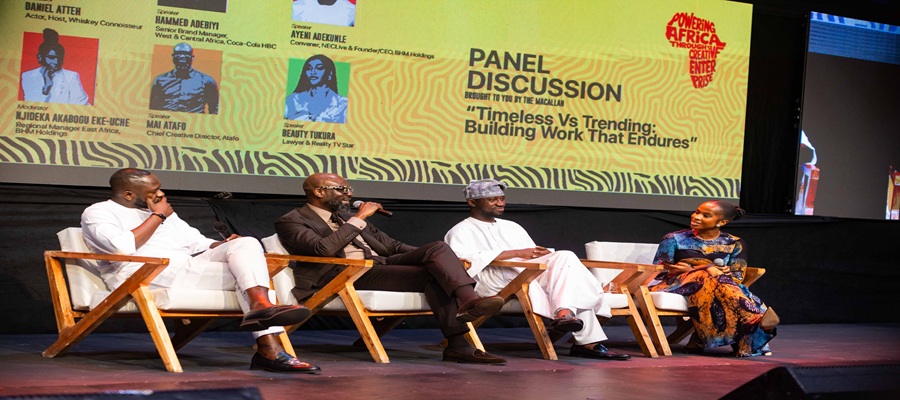
ID Africa, organisers of NECLive, West Africa’s largest annual gathering of creative industry professionals, will hold the conference’s 11th edition on November 12, 2026, at Alliance Française, Lagos. Themed “Home Advantage: Transforming Local Demand into Global Power,” this edition is built around the argument that Nigeria’s strongest bargaining chip in global entertainment may no longer be international validation, but the scale and value of its own domestic market.
“Nigeria has already demonstrated that its creative industries can capture the world’s attention. The next opportunity is to understand how the strength of our domestic market can help us build greater ownership, attract investment and strengthen our position globally ” said Ayeni Adekunle, Founder and Convener of NECLive.
“Home Advantage is about moving the conversation beyond how far our creativity can travel to what we can build from the market that exists right here.
“It is about ownership, investment and creating stronger systems that allow local demand to translate into sustainable power.”
For over a decade, the industry’s growth story ran in one direction: international validation. A Netflix deal, a UK chart entry, a Grammy nomination, these were the markers that a Nigerian creator, or Nigerian content, had “made it.”
NECLive 11’s theme argues for a different sequence: that scale at home is what should now buy Nigeria leverage abroad, better deal terms, equity stakes, a stronger negotiating position with the platforms and partners it once simply courted.
The numbers make the domestic case. Nigeria’s Arts, Entertainment and Recreation sector grew 11.93% in Q2 2026, according to the National Bureau of Statistics, nearly three times the country’s overall GDP growth rate of 4.43% for the same quarter.
Cinema tells the story most visibly: the box office closed 2025 at a record ₦15.6 billion, up 34.7% year-on-year, with Nollywood outselling Hollywood locally for the first time, 49.4% market share against 48.8%, per FilmOne Entertainment’s Nigeria Box Office Yearbook. By mid-2026, Funke Akindele’s Behind The Scenes had crossed ₦1 billion in 19 days.
Data from NECLive’s State of Nigeria’s Creative Economy 2026 Report underscores this home reliance, showing that 56% of creative practitioners rely on local clients as their primary source of income, compared to just 19.4% who draw their primary income from international markets.
Yet access to affordable funding and reliable local distribution networks, rather than physical tools, are cited as the primary structural gaps holding practitioners back, confirming that while domestic demand is proven, the capital pipelines to scale it remain severely underdeveloped.
But growth and reach are not the same thing, and this is where the theme’s harder questions live. Ticket prices have more than quadrupled since 2019, and the average cost of 1GB of data more than doubled between 2023 and 2025. Nigerians now spend an estimated ₦7.6 trillion a year on internet access alone.
Technical infrastructure constraints compound these costs: the NECLive report identifies power outages and poor internet connectivity as the single biggest daily obstacle for practitioners, ranking well above funding delays, IP theft, and regulatory hurdles combined.
Moreover, 83% of creative professionals report losing over 10% of their weekly productive time to non-creative administrative burdens, such as chasing payments and managing logistics.
Taken together, this suggests much of the current boom is being driven by deeper spending and effort from an existing base of consumers and practitioners, not necessarily a widening one — a distinction that matters if “local demand” is meant to be the foundation of a global strategy rather than a ceiling on it.
Nigerian music’s 30 billion streams tell a similar story: strong headline numbers, but with significant revenue leakage to intermediaries, and most Nigerians actually discovering and streaming music on Boomplay and Audiomack rather than Spotify, because Spotify’s economics assume an affordability most local users don’t have.
This is happening as the platforms that once offered Nollywood its route abroad step back. Amazon Prime Video has exited the Nigerian market outright. Netflix, while denying an exit, has slowed new Nigerian original commissions, citing subscriber numbers that haven’t matched the market’s population scale, alongside currency devaluation and piracy.
The retreat sharpens the question NECLive 11 is built around: if global platforms are no longer the guaranteed route to scale and revenue, can the domestic market itself be structured to generate both?
That is the real test of the conference’s theme, not simply whether home demand is real, which the data already answers, but how it gets converted into leverage: equity stakes in the platforms and distribution channels serving Nigerian audiences, stronger IP and royalty structures for creators, pricing models that reflect local affordability rather than global assumptions, and infrastructure investment that grows the addressable audience rather than just extracting more from the existing one.
Affordability gaps, diaspora dependence for hard-currency revenue, and uneven access outside major cities remain open problems. NECLive 11’s task is to move the industry from citing its numbers to building the systems that let those numbers translate into ownership.