




























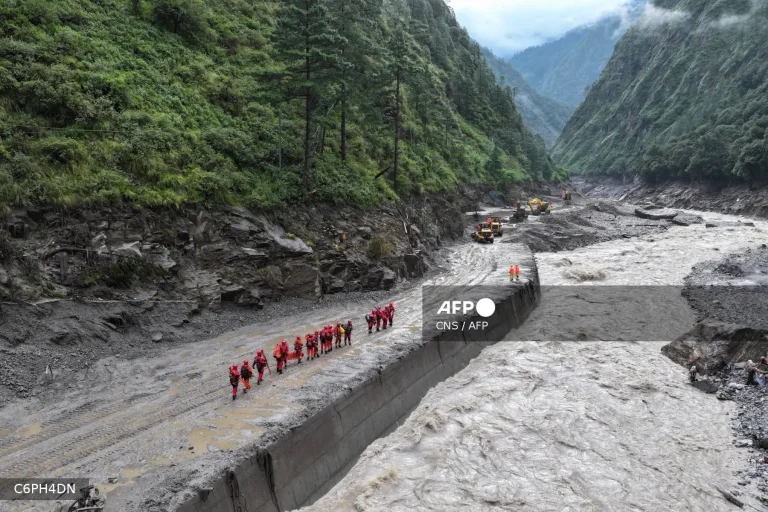
What began as a journey of spiritual renewal to the sacred Mount Kailash has turned into tragedy for hundreds of pilgrims and residents caught in devastating floods across the Nepal-Tibet region.
The floods, triggered by a glacial collapse, sent a powerful wall of water, mud and debris through communities, destroying homes, sweeping away bridges and leaving hundreds dead or missing in Nepal and China.
Among those caught in the disaster was 27-year-old Laloma, a Nepali mother who was rescued on Thursday from the badly affected town of Syabrubesi alongside her infant son and husband.
After spending a freezing night sheltering in a school, Laloma said she witnessed two buses carrying Indian pilgrims travelling towards Kailash Mansarovar being swept away by the floodwaters.
“They are all gone,” she told AFP.
Mount Kailash, a 6,638-metre-high peak in the Himalayas, is considered sacred by Hindus, Buddhists and Jains. Hindus regard it as the abode of Lord Shiva and Parvati, while Tibetan Buddhists associate it with Mount Meru, the spiritual centre of the universe.
Climbing the mountain is forbidden. Instead, pilgrims undertake a roughly 52-kilometre circuit around its base, a journey that typically takes about three days.
For thousands of pilgrims, the trek to Mount Kailash and nearby Lake Mansarovar is regarded as a deeply spiritual experience and an opportunity for reflection and renewal.
But the pilgrimage was disrupted by a disaster that highlighted the growing dangers associated with a changing Himalayan climate.
A glacial collapse sent a torrent of water and debris downstream, producing what witnesses described as a tsunami-like surge that overwhelmed settlements and infrastructure.
More than 470 people were reported dead while more than 1,400 others remained missing across Nepal and China.
Sadhguru Weeps for Missing Pilgrims
Indian spiritual leader Sadhguru, whose real name is Jagadish Vasudev, was among those affected by the disaster.
The guru had earlier led devotees on a pilgrimage to Kailash through his Isha Foundation, whose annual “sacred walks” have attracted growing numbers of followers, particularly from India.
In a video message posted from Tibet on Thursday, Sadhguru became emotional as he spoke about his attempts to contact pilgrims who had gone missing.
He said about 77 pilgrims were at a Nepal-China border office when floodwaters swept through the area on Wednesday.
“Literally, the entire group was there in the building. This is a terrible and extraordinary event,” he said.
He expressed concern for the families of those affected, saying he shared their pain and anguish.
With telecommunications disrupted, roads blocked and access to affected areas severely restricted, efforts to establish contact with missing pilgrims were complicated.
Families Left Waiting for News
The disaster also affected pilgrims from other countries.
Logadarrsiny Raman, 26, from Malaysia, said four members of her family were among 17 Malaysians travelling with a Nepali tour operator.
Her parents, aunt and uncle had spent months preparing for the pilgrimage, which they viewed as a significant spiritual journey.
“They felt like this was the right time for them to go for this pilgrimage,” Raman told AFP.
“It was a very pure intention, and that’s why they wanted to go together as a family.”
For Indian pilgrims, the Kailash Mansarovar journey is organised annually by India’s Ministry of External Affairs in coordination with Chinese authorities.
The pilgrimage resumed in 2025 for Indians after being suspended following a border clash between India and China in 2020.
The latest disaster has now transformed what was meant to be a sacred journey into a desperate search for survivors, as families wait for news of loved ones and authorities confront the enormous challenge of reaching communities devastated by floods and landslides.
The tragedy has also renewed concerns over the vulnerability of Himalayan communities and pilgrimage routes to extreme weather events, glacial instability and the wider effects of climate change.